

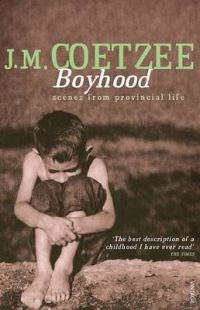
Title: Boyhood
Author: JM Coetzee
Publisher: Random House
ISBN: 9780099268277
Allow me to tell you that my first reading of Boyhood1[i] was on a warm-breezed spring evening in 2004, on the consecrated sands of Half Moon Bay, at the edge of the eternal Pacific Ocean. I had never before gone to Half Moon Bay, or seen it’s particular manner of nesting seaweed, shells and pebbles. The forethought was to romance my rudimentary reading of John Coetzee – to experience his never-before read words, in a place never before seen, felt or smelled. For me, each writer has his/her own place of some wild seashore or forgotten rock (forgotten by all else). As for John Coetzee, it will always be at Half Moon Bay that he penetrated my mind and soul with his words.
Some years later I read Boyhood again. This second time, I was in the air and above an overcast sky, en route to Edinburgh. I ended up finishing the last few pages that evening, in bed, with frozen nose and hands, in an attic room of a Scottish bed and breakfast, located not far from the fortress. The snow fell fiercely the following morning. By the time my second coffee arrived, “What a charming boy,” I said to myself – you know, the little boy, John, in Boyhood – what a gripping life his mum, Vera, must have had with this little devil.
Boyhood: The introduction and ensuing tale are elegant, indeed, merely because the master has written it. Had Boyhood been the product of any living white Western writer of our time it would have missed that certain softness and depth. It is precisely on account of Coetzee’s gentle whip that the psychological torture of Sisyphus in some of his stories are not oppressive (eg, Waiting for Barbarians; Disgrace; Slow Man; Dusklands, and, indeed, Michael K) – Coetzee’s stories lean toward the darker tones of grey, as does his stream of mind, I imagine. Thus, it is because the eye of his soul is in a class of its own that the verbal materialisation of this immaterial manifests itself in stories that are certainly la crème de la crème. Case in point: Boyhood.
In the “scenes from provincial life” one is sophisticatedly introduced to unsophisticated John – a ten-year-old (in 1950) white boy in South Africa. At first sight, this little boy has a nonsensical view of black and white South Africa, and holds stubborn and strong opinions about everything that concerns it. Boyhood thus most immediately concerns a quasi-solipsistic yet egocentric John.
John lacks gumption to stand up in society and is crude in character. This latter element one overcomes and even grows to appreciate. On his South African shore, from a young age, he hides in whichever seashells to avoid the judgment of the sharks of life. John’s tale is the universal tale of all who are “gritting the teeth and enduring” life at home and school, all the while waiting for the moment of maturity that grants them the grip to assume control – over life and destiny. Over the course of his tale’s being told our crude and diffident protagonist displays a number of characteristics more often condemned than praised by his creator and narrator, Coetzee.
Coetzee portrays an egomaniacal child in Boyhood. Little John wants from his mother more love than she is capable of giving, and “he does not want her to have a desire of her own2[ii] for example. He is in constant fear of her escaping from him to her own desires. Without comprehending that his mother would never leave him (or his brother, David), he wants her to wait for Godot,3[iii] until he himself escapes to his own desires – leaving her behind. But will he ever be able to escape to his own true desires? Perhaps not.
Little John is insecure: “He keeps driving her [his mother] to corners, demanding that she admit whom she loves more, him or his brother.”4[iv] In his mind, love is something situational or perhaps visible. In other words, what he wants is not just to feel her love, but to see it in some peculiar way, all the while being aware of the fact that he cannot return this love in kind. Neither does he want to return it. He wants her to suffer and is almost strangely proud: “His heart turns against her […] he is well aware what a betrayal this is.”5[v] It is heartbreaking that he, unfortunately, never realises that she loves him – has loved and will love him – unconditionally and eternally. Alas, “never will he be able to pay back all the love she pours upon him […], he will not kiss her, refuses to be touched by her. When she turns away in silent hurt, he deliberately hardens his heart against her.”6[vi] Almost pathetic.
Mind, I say “almost pathetic”, because I am using the adjective in its literal meaning – as in Greek, pathetikos – because he is a piteous and confused child: for example, he has never been beaten with a cane like other boys in his school, and even the idea of being beaten makes him squirm with shame. On one hand “he wants his father to beat him and turn him into a normal boy.7[vii] He further blames his mother for not beating him (and therefore transferring the responsibility of his not being “a normal boy” to her inaction), while expressing gratitude for her not letting his father beat him (save that one time, because Vera had had enough).8[viii] On the other hand, while listening to his father and uncles, and the stories of the famous canes, he observes certain nostalgia and pleasurable feeling and finds in himself a deep shame for not having been beaten at school. This longing for the cane, however, is not sufficient for him to seek a permanent end to the shame in the case of being beaten by one – at which point, “there will be no way but to kill himself.9[ix] That is to say, even though he is ashamed of not being beaten, he would kill himself if he were beaten – yes, thought-provoking child.
Withal, though his mother never crowns him as such (an inaction for which he wants her to suffer), John is a self-proclaimed prince10[x] – perhaps he wants to be her Oedipus, or perhaps not. He is a little South African Socrates, though. He asks questions and makes statements that do not merely concern his mother, himself, and his father, but also all aspects of the land and people of South Africa and its identity (among his other questions about Hollywood movies, or the beginning of the universe).
He examines his character in an unforeseen way, and one is left wondering if he is the person that he purports to be. He is a liar, he tells himself, and is cold-hearted too. He is a liar to the world in general, cold-hearted toward his mother – he appears to have no doubt in his heart. His only excuse is that he is merciless to himself too. His common sense is that he lies, but he does not lie to himself. This self-convincing method of John, throughout Boyhood, reminds me of Descartes’s Discours de la méthode (Discourse on the Method, 1637): he says, “Le bon sens est la chose du monde la mieuxpartagée” – “Common sense is the most evenly distributed thing in the world.” Descartes claims that everyone thinks he already has enough of what is called common sense and does not desire more of it. However, it is not enough to have a good mind, Descartes goes on.
You see, Boyhood’s little boy has good common sense, but his flaws arise from not applying it properly.
Coetzee is a skilful didactic lecturer as well. He withdraws himself from those pages, leaving one alone with his faint shadow and words, without ever telling one what he is really saying. One has to labour on his work sentence by sentence, word by word, even syllable by syllable, to figure out what he is saying – whether he is saying what he seems to be saying, if what he is saying means what he means to say, if what he means is what he is saying in the first place. Though to a lesser extent, Boyhood necessitates similar labour – especially once one catches the drift that the waves of Boyhood originate in Coetzee’s Stranger Shores.11[xi] It appears that significant parts of Boyhood are conceived from Coetzee’s reflections on The Memoirs of Breyten Breytenbach, as illustrated in the pages of Coetzee’s Stranger Shores.
Boyhood is a book to seize referrals, depictions, and allusions as well (eg, “golden fleece12[xii] ; “women full of scorn13[xiii] ); it thus feels quite appropriate to borrow Coetzee’s lexicon to illustrate Boyhood: Coetzee uses Boyhood “to lash out, in anguish and bitterness, in all directions.14[xiv] Coetzee claims that the “best pages” of Breytenbach’s book address a more intimate and more fundamental concern: what it means to him to be rooted in a landscape, to be African-born.15[xv] Nonetheless, the same phenomenon occurs in Coetzee’s best pages. In other words, the best pages of Boyhood address an intimate, cherished, and even more essential and fundamental apprehension – what it means to this little boy to be rooted in a farm in Africa.
It is the farm – thus the soil of Africa – that speaks to little John. He is aware that belong is the secret word that binds him to the farm. What he does not speak out aloud, but believes in his heart to be true, is even more indispensable: what he keeps to himself “for fear that the spell will end, is a different form of word: I belong to the farm.16[xvi] I suspect that it is possible that he means “I belong to Africa.” Either way, what a wonderful sense of deliverance, what a wonderful sense of realisation of, and finally finding, one’s profoundly unfolded identity: it is rather enchanting for a ten-year-old child to realise this – such a solid sense of self and belonging is something that I myself have been searching for, for five decades.
Despite all his loathing for where and how he lives, his comprehension of his belonging to his grandfather’s farm, Voëlfontein, thus Africa, is the little boy’s moment of epiphany. This is why Coetzee, in his essay on Breytenbach, quotes Breytenbach: “To be African is not a choice, it is a condition […]. The earth was the first to speak. I have been pronounced once and for all” (Breytenbach p 75; Stranger Shores p 251). The little boy understands this representativeness. Not only that, but he examines his life as an ancient Greek philosopher would, only finally to accept his fate: it was not a choice to be born African, it was simply a condition. (By the end of the story this condition is revealed to also have been a secret and sacred choice.) Those sensitive words that he had trapped in his bosom for ten years he now can speak aloud, out in the veld – only when alone.
Alone he may be, but he is not lonely: the farm, the soil, is one of the two mothers he belongs to, he tells himself: “Twice born: born from a woman and from a farm.17[xvii] Indeed, in other words, from his mother, and from Africa. John has two mothers, yet no father. He rejects his biological father (Oedipus complex, one imagines). What he does not yet realise is that Africa is his second father. If the farm and the woman who gave him birth are his two mothers, is it not true, then, that his biological father and Africa are his two fathers? What he does not see is that when he consents to being born from the farm, he does so with the unacknowledged yet inherent acceptance of Africa’s being his father.
The biological father, whom he rejects, however, comes from the farm as well – the soil of Africa that is to be owned and rejected at the same time. Yes, the earth is the first to pronounce who the newborn baby is. Nonetheless, what I want to tell this boy is that this identity expires upon death. Despite his silent satisfaction with his “condition”, there will be no countries, continents, languages, races, names scribbled on identity papers in the next world, I want to tell him. Alas, he is too satisfied. And in this satisfaction lies his vulnerability: out in the veld, he ritualistically washes his hands in the dust, because he is, in fact, happy with his identity: “[B]elonging to the farm is his secret fate, a fate he is born into but embraces gladly […] when he dies he wants to be buried on the farm. If they will not permit that, then he wants to be cremated and have his ashes scattered here.18 [xviii] Thus, the farm is his first and last home – perhaps his only home. Africa is his and he is Africa’s. He knows it, and gladly embraces it, if not as a whole; he will embrace this land, this farm, this soil, with his ashes. Perhaps, Boyhood projects an impression of an impatient desire to grow up on the part of its protagonist, but on closer examination, it becomes evident that this little boy never wants to grow up – not really. John does not want amendment. As witness to his deliverance, one does not want him to change either. On that warm breezed spring evening in 2004, I certainly did not want him to change.
I more than often remember that first time I went to Half Moon Bay to read Coetzee: I had a small picnic basket in one hand and Boyhood in another; I sat on an empty wooden bench, before the ocean, and took out my viands upon a napkin: a mini-pack of toasted bread; a bunch of dark-purple grapes, still with water drops on their skin; Brie cheese – and a tiny jar of salted almonds. In the breeze, I felt vanished from history and had absconded from a future, existing solely for that moment, drifting to discover John. Boyhood’s John, with darkness in his heart, who utters constant melancholic doubts and nostalgic apprehensions upon life. Now, my last time with Boyhood, at the same spot as my first time, I gaze at passionate wet sands of the beach. The book still between my hands, I am reading his footsteps. I can vividly see him on the sand, his heart full of sorrow: one wants to embrace him; one wants to tell him he is loved. One is left with no alternative but to adopt him: the only orthodox thing to do, really. At the end of the story, John wonders how will he keep all the books, all the people, all the stories, in his head. If he does not remember them, who will? he asks. Say, who will, really?
As I close the familiar pages, for the third and the last time, getting ready to wander away from Half Moon Bay, barefoot, leaving the ocean behind me, with the Bach-like sounds of the waves crushing on the desolate rocks, “I shall remember all the books and all your stories,” I say to myself; “I shall remember you, always”, all the while that perpetual breeze of the eternal Pacific Ocean on my face – you know, the sort of breeze that takes the mask off one’s face and purifies the soul.
References
1[i] JM Coetzee, Boyhood: scenes from provincial life (New York: Penguin, 1998).
2[ii] Ibid, 4.
3[iii] Here I am alluding to Samuel Beckett’s Waiting for Godot.
4[iv] Boyhood, 13.
5[v] Ibid, 3.
6[vi] Ibid, 46.
7[vii] Ibid, 13.
8[viii] Ibid, 6–9.
9[ix] Ibid, 7.
10[x] Ibid, 12.
11[xi] JM Coetzee, Stranger Shores, Literary Essays (New York: Penguin, 2001).
12[xii] Boyhood, 82: “[O]nly sheep mattered, sheep with their golden fleece” – from Greek mythology.
13[xiii] Scorn, a word whose association in most minds is a reflection on its contextualisation in a sentence either in Shakespeare’s Hamlet, William Congreve’s The Morning Bride, or Joseph Conrad’s Lord Jim.
14[xiv] Stranger Shores, 250.
15[xv] Ibid, 251.
16[xvi] Boyhood, 96.
17[xvii] Ibid, 96.
18[xviii] Ibid, 97.
Teken in op LitNet se gratis weeklikse nuusbrief. | Sign up for LitNet’s free weekly newsletter.