

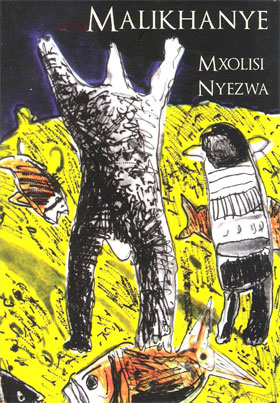
 Malikhanye
Author: Mxolisi Nyezwa
Publisher: Deep South
ISBN: 9780958491594
Click here to order a copy from Deep South.
Malikhanye is Mxolisi Nyezwa’s third collection of poetry, continuing his trend of potent and highly lyrical poetry containing the reality of a landscape that is both political and personal, both painful and beautiful, in writing filled with intense and startlingly evocative imagery.
Everyday experiences and things become intensely real in these poems, rendered brutally potent by his use of images and symbols. His steel container in Motherwell where he operates his business becomes a "blue ship" on a shallow sea, symbolising the uncertainty and hardship of poetic explorations into meaning and experience, as well as a sense of alienation and existential solitude. You get compelling pictures of a landscape, one of pain and beauty and intense reality. Mxolisi proclaims: "i’m a shadow/ geometrical/ in a blue ship/ freezing/ or boiling." And elsewhere: "my house is built of sharp stones/ and red quills/ from a hornet’s wings", evoking in startling terms the real nature of the personal and its relation to being.
Being flows in his poetry, boundaries are not distinguished, but shown to be flowing on to one another. In the sequence “Malikhanye”, Mxolisi writes these stunningly pure and potent lines about his son who passed away at the age of three months in August 2007: "you will be water/ you will be birds/ -/ you’re not here/ to live with us/ where trees go/ and segments of breath/ hurtle like raindrops/ from the sky."
Mxolisi is both an intense realist and a magical dislocator of words, a magus and a seer, almost, without imaginative boundaries. He possesses duende, the potent creative spirit that confronts death and life face to face and sings with desperate intensity. He is the man acutely aware of the sea flowing in his palms, the house full of spiders and the geometric pain of love.
Technically he uses a deceptively easy, seemingly flowing form in his rhythm, where one image rolls on to another. He dislocates and defamiliarises syntax to create potent meanings out of simple-seeming phrases. His writing escapes labels. It breathes a heroic defiance in the face of pain and inevitability. His humanism is a desperate and potent awareness of life contrasted with its ephemerality and the often incomprehensible course of events. He avoids weak gentility as well as the meaningless bombast of many active social commentators. Words are handled with a keen understanding of their values, with the result that his poetry is both hauntingly musical and brutal in its pointedness, with echoes of writers like Wopko Jensma in its knife-like phrases. He writes with direct attention to experience, neither cynical nor carelessly optimistic in his tone - it is absolutely essential in its attitude. It is a poetry not about belief, but about complete experience, where one’s inner and outer worlds meet and communicate, the worlds invisible and visible both real.
These are deeply political poems, authentically personal, challenging the clichéd perceptions of the South African landscape. He says in the following haunting lines:
"all i can make of my country/ is a sulphurous compound/ a black room with two gigantic stars/ as thoroughly silent as corpses."
Those lines sum up many things in a devastating manner through their use of overwhelming symbols. The apathy of power, and the meaningless polarised public sense of identity and sense of reality, silent and irrelevant to the real context, its everyday existence and suffering. The gross inequality and division in our country between haves and have-nots. The polarisation of public discourse into meaningless violence. The failure of dialogue between different groups. The discrepancy between experience and reality, and promises and betrayal. The images presented in those lines are both frightening and terrifyingly beautiful, compelling one into a potent experience of the reality.
The climax is the sequence of poems “Malikhanye”, dedicated to his son, Malikhanye Nyezwa, who passed away at the age of three months. It is a work of haunting depth and tender irony, populated with startling images and intense juxtapositions. In its height it is the equal of Garcia Lorca’s “Elegy for Sancho Meijas”, and very reminiscent of Vallejo’s meditations on life and mortality and human suffering, full of probing and relentless reflections. It is at once political and personal in dealing with the landscape of the personal and personal loss within the context of the South African landscape. It is both cathartic and devastating. “Malikhanye” is sublimity, in the sense that sublimity is a transcendence and re-evocation of experiences and things. Sublimity can be well defined as the dislocation of language revealing startling depths and intense meanings. There are no false consolations, nor easy cynicisms. There is no mannerism. One is overcome by the sheer courage of his words, the candid images which step forward asking for no pity but powerfully resonant.
Nyezwa’s poetry is the liberation of language. It defies labels. It is filled with images both real and surreal, a world both personal and political, revealing a landscape, its visible and its invisible aspects. It blurs distinctions between the epic and lyrical in its attitude to existence. It burns and is embued with a deeply tragic irony, but never ever with pathos, always a sense of defiance in the mere activity of writing and the imagination which recreates perceptions. I define Mxolisi Nyezwa’s work as transcendently sublime in its startling evocations of reality. He continues to confirm his place as probably one of the best poets writing on the continent today, and with time will be recognised in the same bracket as Lorca and Vallejo. At present, he is one of the greatest poets this country has ever had writing in English, synthesising and compressing diverse realities and experiences with acute precision.
Mxolisi Nyezwa’s poetry is in a profound sense about being, existing and experiencing reality with potent and engaging awareness. I encourage you to buy the work of a living master, and engage openly with the startling evocations of his living words.