

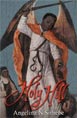
 Holy Hill
by Angelina Sithebe
Category: Fiction
Publisher: Umuzi
Click here to purchase Holy Hill from kalahari.net now!
It has not been since Ben Okri’s the Famished Road that I have read a story about a believable connection between the human and spirit worlds; not since Alice Walker’s Colour Purple or Toni Morrison’s Bluest Eye that the theme of the female body as a site of violence has been so palpable; and not since Charlotte Brontë’s Jane Eyre that cruelty under the guise of the ultimate reward of "heaven" and eternal happiness has been exposed as cruelty masked as discipline. Violence against women, HIV and AIDS-related prejudice, the "female question", institutionalised discipline and the fallacy of "the place of gold" are but some of the themes that are interrogated by Angelina N Sithebe in her debut novel, Holy Hill (Umuzi, Cape Town, 2007). Not that I am comparing Sithebe to these acclaimed authors, but the audacity of her resolve to step boldly where most of us still fear to tread should be applauded.
Holy Hill is Nana Mlonzi’s story as told by her host spirit, who was ever present in her life long before her parents "even dreamed or made her". The spirit decides to tell what it believes to be the true version of Nana’s story. This story is told retrospectively, weaving the past and the present in the narrative. Up until this written down version, Nana’s story has been told by people who wanted to tell their own stories and have, as a result, distorted it:
Over the years I have heard them tell their accounts of her. Their versions are weathered and stained, painted with faded streaks. Woven with their own histories, dreams, visions, lies, self-righteousness, guilt and fear. Their stories change, fluctuate with the inflation of their own realities and imaginations. (24)
The spirit therefore believes that its own version of Nana Christina Mlonzi’s story is the only true version because it would not be watered down or even overshadowed by the spirit’s own story. We as readers are made to believe this account as genuine because in a way the spirit's story and Nana’s story are the same story.
The novel opens with a prologue and ends with an epilogue, with five parts in between. Each of the parts is epigraphed by a verse or verses quoted from the Biblical book of Matthew. The epigraphs read like prophesies of what is going to take place in each section of the book. Each part is in turn a fragment of Nana’s life story and journey into adulthood that ends in tragedy.
Margaret Mlonzi, Nana’s mother, who is part of a society that still believes in the value of a boy as the proper "gift" to their husbands and families has so far been spared the "affliction of not being able to conceive boys" (29) because she has two already, Bandile and Lethu. She gets pregnant for the third time and the oracle has predicted that this one will be another boy. All is well until the new arrival is a girl! To make matters worse, she does not meet the community’s or even her mother’s standard of beauty because she is too dark for a girl. Not only is Nana dark and ugly, she is a girl who "behaves like a boy" (43). She does not care about keeping herself clean, loves the outdoors and is different in that "for the rest of her life in this world she would be open to others from other realms". It is this connection with the other realms that complicates Nana’s life even more. She can see the future and this is interpreted as either devilry or witchcraft. Because Nana is different her parents, especially her mother, is embarrassed by and disappointed in her. They decide to send her to boarding school so that the Sisters can raise her to be a good child.
Nana perceived her dispatch differently. She knew she was being sent away
[b]ecause she was a problem. She moved too fast, talked too much, she was lazy. She stared at adults when they were speaking instead of looking down. She told adults they were lying when she caught them at it. She was rude to her brothers. She did not know how to cook or bake. She was so untidy her bed looked like a polecat’s hole. (54)
Interestingly enough, Ma Mlonzi expects Nana to be able to do all the chores that are assigned to girls even though she did not take the time to teach her any of these chores, as if the "condition" of being a girl is inborn. Nana as a girl is therefore supposed to know these things because they are inherent to girls. Exasperated by the girl child who does not know how to shoulder her burden, they send her to the Catholic boarding school to be taught discipline and how to be a good child.
Pumla Gqola makes a salient point about discipline in her Ruth First Lecture of 2007, that "Refusal to adhere to certain precepts is often seen as the absence of discipline. One of the problems with this concept of discipline, which seeks to repress interiority in favour of outwardly visible manifestations of order is that it also helps to mask other repressive systems that work to support the "ideology of militarism".' The reputation of Holy Hill to instil discipline in young girls prompts the Mlonzis to send their daughter to Holy Hill to learn the manifestations of a disciplined life perceived to be lacking in her.
‘One is not born, but rather becomes, a woman’ this expression rings true throughout the sections that follow in this text. Parts two and three deal with the abuse that Nana suffered at the hands of the "Sisters" that where entrusted with the task of turning her into a good girl. The school and how it operates is portrayed as another institution that engenders the idea of the "ideology of militarism". The children are taught to survive with less than nothing, just like soldiers, thus preparing them to be soldiers of the burden of womanhood. She also suffers violence at the hands of the supposedly "good" lawyer boyfriend. Home was no better either, as Nana had to contend with back-of-the-hand slaps from her mother and constant abuse from her jealous elder who feels his monopoly over the mother’s attention is under threat. Both sections two and three highlight violence and silence as interrelated facets of the ambit of discipline. The "Sisters" had:
[V]owed never to turn away any soul. They were sure they would triumph. Nana knew the Sisters had already started to fight bitterly for her salvation. Whipping her physically, emotionally and spiritually to break down the will of Satan. Nana was the chosen ground for the battle. (87)
The ‘Satan’ in Nana is the self that refuses to be confined by a socialization that demonizes her existence as a person hence the desire to make her a woman. All these people that are part of Nana’s life projected on to Nana their feelings of self-hate through the violence they meted out to the young girl and woman. The author tackles these issues with a sobering honesty that unmasks the violence done by the Sisters to Nana and other girls at the boarding school under the guise of discipline. When the nuns beat Nana until she became unconscious for being "too clever" (99) at mathematics they got away with this act of cruelty because Sister Dominic, the head sister, who is almost sadistic in her disciplinary measures, "did not tell the parents what had happened … She knew that Nana would never tell them either." (100)
Although Nana’s silence does not protect her from further violence it most certainly shields the perpetrators from exposure. The parents were only too happy to see
[how well] the Sisters had changed their children, so that even to their parents they all looked the same. Obedient, clean, quiet children ready for the hard life of thorns that awaited them. They couldn’t run around laughing and screaming if they wished to survive adulthood. (99)
Like all institutions, Holy Hill could be subverted. The girls also learned to subvert the teachings of the school within its premises and be different individuals. As a result, when Nana left the boarding school she did not show outwardly discipline, and she had also learned that
adults could be cruel, and they sided with other adults against children or the weak, while other adults looked on and cheered in approval. She had learned to use the biting tongue of the girls from Zululand, the shy wisdom of the girls from Durban, to play with words like the Koloni girls. To show superiority like the girls from Egoli. To hiss and giggle like them too. And to dress like them. She has arrived in the world. (115)
The beast of burden trained at Holy Hill to carry her burden of womanhood like the soldier that she is, meets Peter. They move in together. He physically and sexually violates her. When she decides to speak out and tell her mother that that the "good boy" who calls her "is’febe, Nyumbakazi" beats her, she is told to "Bekezela – tolerate and persevere. Be patient, you know how you are like", as if the abuse is her fault. "She had to, she knew how to, so she persevered." (121-2) Besides, it was believed it is love that made Peter beat Nana up and that was reason enough for him to "enter her body and unleash his violence inside of her".
Part four of the book introduces us to Claude, an illegal immigrant and a desperate soul in need of salvation. He lives by pickpocketing rich, vulnerable women. He is also a part-time gigolo and drug dealer. He is already a drug addict by the time he meets Nana. Their meeting is orchestrated by Nana’s spirit who needs to "replenish himself in order to remain on earth"(178). Claude is therefore the perfect candidate. He was lured to South African shores by the prospects and the riches associated with "the city of gold". He is desperate to find a rich South African woman who will take care of him and his expensive habits. Nana looked as if she fitted the profile. Through Claude the text interrogates the violence against women that is prevalent in this country with the added dynamic of the immigrants from other African countries that are just as patriarchal as the South African society, if not more so. Claude also has war experiences that have taught him to think very little of human life. To him women were his ticket to the good life, but Nana made him feel "[e]ngulfed by nostalgia for a long gone time, before he lost his innocence"(167), but she is also the meal ticket because ‘it’s hard to find work here if you’re a foreigner (167-8). He also can imagine himself snapping her delicate neck just as he was taught in the army camps.
In the last part of the text, Nana's and Claude’s lives are presented as intertwined. This section is titled "Naclaunade", a fusion of their names. The epigraph ends with a warning to "keep awake then; for you never know the day or the hour". Although Nana could see into the future and knew that she was going to die and that Claude was going to be the one to kill her, she did not know the "day or the hour"(191). Nana’s spirit presence that is desperate to remain on earth, sacrifices Nana to Claude so that it can live through Claude, thus connecting their lives forever. Nana’s spirit decides to tell Nana’s life story because, like every other South African woman that is killed, raped, abused by her spouse, Nana will be only a statistic when the sensation created around her death by newspapers ceases. It tells Nana’s story because if no one does, "all that will remain of Nana will be a few anonymous black-and-white paragraphs squeezed into sensational newspapers" (221).
Nana, like every other South African woman, deserves to have her life story told without the sensation that sells newspapers. Sithebe does exactly that in Holy Hill. She writes Nana’s life story so that it is known that it was a person, a woman, a daughter, a sister, an aunt called Nana Christina Mlonzi who died of stab wounds in that tub. Before the number she will be given in the statistical records, we all need to remember that she had a life.
The rawness of the acts of violence committed in the book and the simplistic language with which they are told makes this book a valuable contribution to breaking the numbing silence that still surrounds women’s experiences of violence in this country. The story reads so much like the everyday life of so many women that one has constantly to remind oneself that it is actually a work of fiction. It pulls you to and fro between the two realms. The fact that this story is told by a black woman from her perspective makes for a welcome change. The translations tend to stifle and interfere with the flow after some time, though, especially for a reader who has a command of the indigenous vernaculars.
References
Gqola, Dineo Pumla. 2007. After Zuma: Gender Violence and our Constitution. Ruth First Lecture, November 2007