

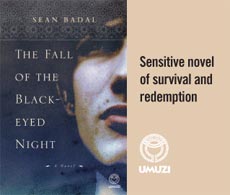
 Title: The Fall of the Black-Eyed Night
Author: Sean Badal
Publisher: Umuzi
ISBN: 9781415200544
Publication date: July 2008
Pages: 192
In 472 BC Aeschylus, the father of Greek tragedy, wrote The Persians, a play about the Persian leader Xerxe's failed campaign against the Greeks. It is a play of lamentation in which the pride of one man has brought pain and defeat to an entire nation; and where the excesses of the young are deplored by the wiser, older generation. In this regard the play still bears great relevance, specifically when read in light of the many wars and conflicts which are ongoing worldwide. It is perhaps for this reason that Sean Badal has chosen to borrow a phrase from The Persians to serve as part of the title for his recent novel, The Fall of the Black-Eyed Night. The novel opens with the full quote:
With wail and moaning, was possessed around,
till black-eyed Night shot darkness o'er the fray.
These ills thou hearest: to rehearse the whole.
Certainly, The Fall of the Black-Eyed Night is filled with ills: drugs, death, violence and various other causes for wailing and moaning; but it is there that the comparison ends. The novel relates the story of a young Muslim man, Shehzad Shadhili, who recently returned to Cape Town after having experienced the Islamic terrorist scare known as 7/7 which occurred in the UK in 2005. An interesting plot is promised regarding Muslim life in Cape Town. Questions arise, such as:
"What's a good Muslim anyway? Obeying the five pillars of Islam? Doing your salat, giving zakat, performing hajj? I know people who do all that and are still wife-beaters and adulterers. So what's a good Muslim?"
In addition, Shehzad recalls how after 7/7, being Muslim, or simply looking Muslim, became problematic. But more than causing prejudice against Muslims, the terrorist attacks brought to the fore certain resentments felt by Muslims regarding different branches of Islam. Shehzad complains that the Saudis use their money to push their extremist views on to the rest of the world; meanwhile, as his father says, "Wahabism is not Islam. It's the Saudi version of Islam." Complicating this situation is the fact that the new imam, Rustom, who has replaced Shehzad's father, is Saudi Arabian. This causes great conflict when it is discovered that a golf estate is going to be built on the mountainside where the kramat of Shehzad's grandfather, also an imam, is situated. Unsurprisingly this news upsets not only Shehzad's father, but also other members of the Muslim community. However, Imam Rustom declares that worshipping of graves is against the tenets of Islam and consequently he issues a fatwa against such behaviour. Feeling the betrayal and pain of his father, Shehzad attempts to resolve the problem by creating a false dossier of evidence showing Rustom to be a Muslim terrorist. The results are devastating, with Shehzad ending up in hospital after being attacked by unknown men.
It is this plotline, as I say, which proved most promising and which should have taken up the bulk of the novel. Had Badal taken the time to extend this section, to explore it and interrogate it more completely, the novel would have been particularly topical, and the choice of title would have been more relevant. Unfortunately, this plot is sidelined in favour of rather more inconsequential encounters with several characters from the upmarket hotel in the city centre where Shehzad works. There is his white married lover, the Chinese Muslim chef Wu, a German property mogul and his daughter, as well as the cast of a Bollywood film. With these dominating the text, the actual matters of interest are neglected, and consequently the action is crammed into the last forty or so pages, leaving one with an unsatisfactory ending.
Furthermore, Badal is guilty of that sin which so many writers commit: over-writing. His love of adjectives and alliteration is apparent from the outset, with the result that his sentences are weighed down by them, such as in the following:
The pale glow of the streetlights fell on the ground, suffusing into vast pools of soft light. A pale white gossamer moon slipped briefly from behind the clouds, casting a ghostly glow on the ground.
His over-writing also manifests itself in an almost endless stream of similes and metaphors which make for painful reading, as in the following two examples:
Street children darted like razor fish amongst the carnivalesque crowds, begging for money and scraps of food. Sometimes they seemed happy just to make contact, to have another human respond to them, even if only with a torrent of abuse.
We're more like ocean liners trying to change direction in the midst of a gale force 10 hurricane. You know, slowly, and with great difficulty.
Were Badal to simplify his style, reading his work would be a far more pleasant experience. In those parts of the text where he has managed to limit himself to straightforward writing it is clear that there is talent - it is merely being drowned.
Another decision on the part of Badal which I found troubling was that each of his 21 chapters was introduced with a quote. These quotes came from sources as diverse as Edward Said, Peter O'Toole, Orhan Pamuk and the comedian Bill Murray. One cannot but question the relevance of these quotes, for there is no unity, no common thread that links them. It seems to me that Badal has "a weakness for quotable wisdom" as does his character Shehzad, and that this weakness has resulted in this rather confusing (dis)array of quotable quotes.
As a whole the novel disappoints. The places in which it succeeds are limited. Badal does a convincing job of locating the action in Cape Town. Close attention is paid to details such as buildings, roads and areas. He also introduces a number of Arabic, Chinese, Hindi, Urdu and Persian words, as well as including Cape vernacular. These establish a sense of authenticity with regard to the characters. A glossary at the end of the book serves as a useful tool for understanding the meanings of these words.
In the end, returning to Aeschylus, I must ask, "To what fair end are these thy words directed?" And I would suggest that Badal consider this question carefully as he writes, for were he to think carefully about his word choices and his intent, I believe that he could produce a far better novel than the "ill return" which The Fall of the Black-Eyed Night offers.