

...
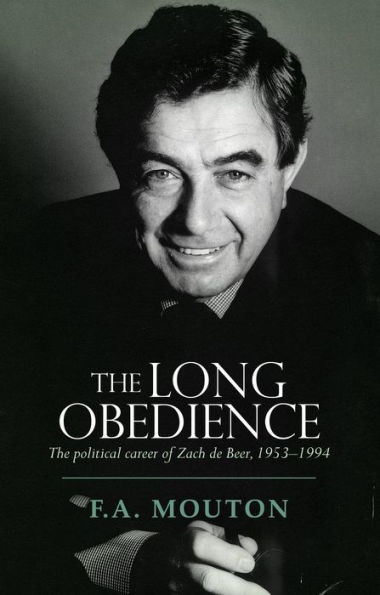
Mouton brilliantly captures how difficult it was in this political climate of extremes for Zach de Beer and his fellow progressives to make headway with liberal ideas.
...
Title: The long obedience: The political career of Zach de Beer, 1953–1994
Author: FA Mouton
ISBN: 9781485314493
Publisher: Protea
[A] liberal is someone for whom the individual is of supreme importance. He believes that every human being must be given the greatest possible freedom to develop his personality, his character, his talents. The liberal, if put to the test, will always be guided by the interest of the individual rather than those of the party, the group, the community or the state. ... [A] liberal is a man who believes in individual freedom and the integrity of the human personality. This belief is the cornerstone of Western democracy. – Zach de Beer, Progressive Party MP
In 1994 De Beer came to explain the policies of the Democratic Party to students at Pretoria university (sic), who were outraged when he stated that as a liberal, he had always opposed apartheid. When he mentioned that he was one of a handful of Progressive Party parliamentarians who had been courageous enough in 1960 to vote against the outlawing of the African National Congress and the Pan Africanist Congress they erupted in contemptuous jeering. It struck me that the students had no knowledge or understanding of the role of liberalism in opposing apartheid. – FA Mouton
Zach de Beer, a household name for decades in South Africa, standard-bearer of liberal values, Progressive Party founder and boon companion to such stalwarts as Helen Suzman, was once also viewed by many of his contemporaries as “a young man with his future behind him”, a not too subtle comment on his sharp-elbowed political colleagues.
His own career, like that of all politicians, it seems, ended in failure, but this is not so much an indictment of De Beer – although there is no doubt he was a fallible fellow – as it is of the conservative constituency of white South Africans, who were infuriatingly unwilling to convert to the humane values that he himself espoused.
FA Mouton has written an engaging political biography here, warmly recommended to everyone of a certain vintage anxious to know what went wrong and why the seeds of liberal enlightenment failed to take root, not only in “old” apartheid South Africa but also in post-apartheid South Africa.
As Mouton points out, after April 1994, liberals received no credit in South Africa for the dramatic changes which had taken place: “The ANC appropriated all the moral capital of the struggle against apartheid. Despite her international reputation as a champion of human rights and the rule of law, Suzman’s portrait was removed from a parliamentary corridor, together with those of apartheid politicians, to be placed in a parliamentary cellar.”
More than a quarter of a century after 1994, the bypassing of the role of liberals, especially those of the progressive parties, is reflected in the absence of biographies on them. The only one since 1994 to be published on a former Progressive parliamentarian is that by Albert Grundlingh, Slabbert: Man on a mission, in 2020.
And yet, as Mouton says, De Beer played a significant role in opposing apartheid. His political career was motivated by the ideal of a fair, democratic and prosperous South Africa in which the rights of all its citizens would be protected. His dedication to these principles contributed to the founding of the Progressive Party in 1961, the party’s durability in the face of numerous defeats and setbacks, and its eventual replacement by today’s Democratic Alliance.
The million dollar question, of course, is whether the changes that eventually occurred in South Africa were the result of the policies which progressive liberals had pursued for years; or was it, in the end, as De Beer’s fellow Progressive founder member, Boris Wilson, asks in his own excellent autobiography (1), internal black defiance and outside sanctions which forced the Nationalists to abandon apartheid?
The questions go farther, as Wilson says. Is there still a role for the liberal in black Africa? Or will South Africa follow patterns set in other African countries, where the black majority does not want the white man to play a significant part in their political and social economies, irrespective of his liberal beliefs?
Reading Mouton, no easy answers to this perennial question are forthcoming. However, as he meticulously retraces the political trajectory which leads us to today’s South Africa through the career footsteps of De Beer, we see how potent an effect the decolonising violence of the Congo, the Kenyan Uhuru and events in northern Angola especially had on the mindset of white South Africans in the period 1960 to 1965 when De Beer was active in the formation of the Progressive Party, the result of a breakaway faction to the left of the United Party of Smuts.
Verwoerd, Nationalist prime minister and architect of grand apartheid and the Bantustan policy, had decided to call a referendum in October 1960 on establishing a republic. Mouton says the republican campaign was bolstered by Verwoerd’s increased stature after a failed assassination attempt: “But what really boosted the republican campaign were the bloody events in the newly independent Congo, and the desperate fleeing of white settlers after the withdrawal of the Belgian colonial authorities.” To secure the votes of conservative English speakers, the NP’s slogan was “To unite and keep South Africa white, a republic now”. In the words of the Rand Daily Mail, the republican referendum had been reduced to “the simple question whether you want your daughter to marry an African, or more to the point, to be ravished by a Congolese soldier”.
We have probably, 63 years later, largely forgotten the shock effect of the Congo events. Certainly the younger generations of South Africans can have no inkling of the impact that the violence in the Congo had on white attitudes in South Africa. A useful authority in this regard is Rodney Warwick (2), whose research shows that the terrible slaughter of white refugees in 1960 had a profound influence on white attitudes in South Africa at exactly the moment when the liberal wing of South African political activity was arguing for greater inclusivity.
By 30 June 1960, the independence process of the Belgian Congo had begun. By this date, 17 African states were independent. But in the Congo was the first of a succession of events where white communities in subequatorial Africa experienced black nationalistic-originated violence of significant scale and extremity. Hundreds of whites were slaughtered. The violence spilled over to the Bakongo areas of northern Angola. Black Angolan subsistence farmers and plantation workers collaborated with groups invading from Congo, attacking and butchering Portuguese rural settlers. As Warwick notes:
Such was the extreme polarization of this period; it was completely and utterly impossible that any liberal democratic South Africa would have emerged in 1960, even had South African whites been willing to negotiate therefore (sic), and obviously they were not. To whites, the Congo and Angolan events, superimposed upon South Africa, seemed the most obvious outcome of any Bram Fisher/Mandela/Luthuli/Slovo-led government. Therefore, Verwoerd’s economically illogical, discriminatory and racially damaging alternative received white South African consent.
Warwick’s study includes news clippings and photos from Afrikaans and English language newspapers that routinely showed ghastly atrocities beyond comprehension.
It was easy, against this backdrop, for Verwoerd to launch a “swart gevaar” (“black danger”) campaign and persuade the fearful white electorate to support his grand apartheid design. Almost as a gift to his campaign in terms of timing, British Prime Minister Harold Macmillan gave his winds of change speech in Cape Town, confirming that Britain would be giving independence to all its former colonies, and white South Africans were therefore on their own.
English-speaking South Africans were also discombobulated by the publication of best-selling books like Uhuru by Robert Ruark, which graphically and terrifyingly captured the Mau Mau uprising in Kenya during this period. Nowhere in Africa was, it seemed, safe for white settlers. A significant number of whites left South Africa for other countries in the early sixties – many of them liberals. Jonty Driver, former Nusas president and Winchester head, wrote a book called Elegy for a revolutionary, which captured the zeitgeist exactly.
Verwoerd seized his moment, promoting his proposed republic and grand apartheid with slogans like “Ons Republiek nou, om Suid-Afrika blank te hou”.
Mouton brilliantly captures how difficult it was in this political climate of extremes for Zach de Beer and his fellow progressives to make headway with liberal ideas. The National Party MPs harboured a special venom towards the few Progressive MPs in Parliament. The Nationalists didn’t want to hear about the dark side of apartheid, as they had convinced themselves that it was a just and Christian policy: “[F]or them any black discontentment with apartheid was the result of communist agitation with liberals acting as their useful idiots.”
Mouton leads us through the labyrinth of in-party fighting in the old United Party that saw colleagues pitted against colleagues. The centre couldn’t hold, as it were, and was falling apart. The original Progressive Party absorbed new members who could no longer abide the United Party, but in the process the Progressive Party ran the risk of becoming ideologically diluted. Individuals, including De Beer, were accused of wanting to occupy leadership positions out of ambition. Margaret Ballinger, the former leader of the Liberal Party, which predated the Progressives, was hostile to them. She was an “unbending” opponent of apartheid, the one person who could match Verwoerd in debates. She blamed De Beer for underhand tactics and, as a result, refused to share her front bench in the House of Assembly with him.
De Beer attracted special ire from the Nationalists because of his fluent Afrikaans. They felt he was betraying the “volk”, but he never flinched from delivering unpalatable truths, telling Parliament: “Progressives would not tolerate the open injustice of the Group Areas Act, nor the miserable indignity of the Immorality Act. We as the White people of South Africa, must choose.”
Verwoerd’s response was that the Progressive policy would lead to black domination, and that a bill of rights could not protect the white minority. He argued that once in power, the black majority would wipe out minority groups – the whites, Indians and coloureds.
Mouton captures the rising tensions perfectly: the Progressives supported a motion by Ballinger that the pass laws and influx control for black people had to be abolished. The motion was rejected by the House, while outside Parliament black anger was building up against pass laws. The newly created Pan Africanist Congress (PAC), in an attempt to pre-empt the ANC, called for a nationwide campaign against the pass laws. Combined with a call for a stay-away from work, black people were urged to march to police stations without their passbooks and to insist on being arrested, and then to refuse any bail. The hope was that the apartheid state’s penal system would be overwhelmed.
In an atmosphere of simmering anger at the apartheid laws, thousands of black people marched on police stations. The police at Sharpeville outside Vereeniging panicked and fired more than 1 000 rounds on between 15 000 and 20 000 protesters at the police station. Sixty-nine people were killed and 180 wounded. At Langa, near Cape Town, a similar incident took place, but on a smaller scale.
De Beer responded strongly to these events: he told Joel Mervis, editor of the Sunday Times, that he was trying to prevent South Africa from becoming a police state. Under the heading “Death and chaos outside – unreality inside”, the article pointed out that while Sten gunfire could be heard on the edges of Cape Town, the echoes of modern South Africa were lost in the House amidst wild cries about a future republic.
De Beer was occasionally forced to compromise, though. In a budget debate, he sided with the government on the issue of land for the Bantustans, arguing that in 1936 a promise had been made to provide this land and this promise had to be carried out.
Space doesn’t allow for a much longer review than this, but suffice it to say that Mouton’s treatment of Zach de Beer’s career covers all the high and low points. We follow his speeches and his parliamentary manoeuvring, and at the same time we enjoy a marvellously concise contemporary history lesson by a biographer on top of his game. All the important events are covered, with De Beer frequently being the Progressive responder: the Cottesloe Church challenge to apartheid; the strange “troika” with Worrall and Malan; the different iterations and mutations of one party segueing into another; Soweto 1976; the difficult period with Van Zyl Slabbert, who seemingly swanned off the political stage with nary a hint of warning, deeply upsetting Helen Suzman; the talks with the ANC by big business which De Beer attended; De Beer’s own periods of business involvement; Colin Eglin’s bad luck with the McHenry saga (being accused of leaking confidential information to the Americans); and De Beer’s eventual uneasy leadership of the Democratic Party until he, in turn, was asked to leave, and his retirement after serving as South African ambassador to Holland.
When De Beer died in 1999, he was lauded as one of the handful of South African politicians who had kept the flame of liberal idealism alight through a very dark night. It is probably safe to say that he would have been deeply disappointed at the erosion of liberal values had he been alive today.
Notes:
- Boris Wilson, A time of innocence, Random Century, 1991.
- Rodney Warwick, “White fears in the 1960s” – 21 February 2013, PoliticsWeb, South Africa.