

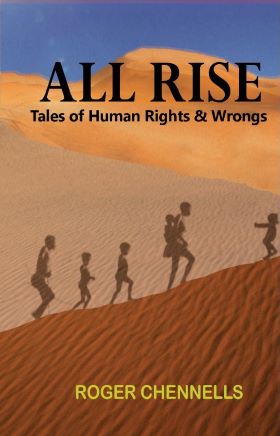
All rise: Tales of human rights and wrongs by Roger Chennells (2023)
Title: All rise: Tales of human rights and wrongs
Author: Roger Chennells
Published by the author, 2023
ISBN: 9780639770420
South Africa has been astonishingly well served by skilled lawyers. From our first chief justice, Sir (later Lord) Henry de Villiers (for 40 years a chief justice – firstly of the Cape Colony, 1874-1910, and thereafter of South Africa, 1910-1914), and on, we have an enviable list of world-class lawyers. By the mid-twentieth century, Israel (Isie) Maisels dominated the bar, obtaining judgments that won Ernest Oppenheimer 1 000 miles of Namibian beach to mine for diamonds; getting David Pratt an “insane” judgment for his attempt to murder Verwoerd; and, as the politics of South Africa quickly came to dominate our society, seeing Sydney Kentridge and Bram Fischer winning “not guilty” judgments for all the defendants in the five-year-long Treason Trial of 1956-1961.
Then came the Rivonia Trial, and the legal team headed by Bram Fischer, and including the young Arthur Chaskalson and George Bizos, saved the lives of some of the most important persons in South Africa’s history. Then there was the Steve Biko Inquest, and again Sydney Kentridge and George Bizos, and also now Ernest Wentzel.
And so the list goes on: Albie Sachs, Ismail Mahomed (the first black advocate allowed to take silk – in 1974, while still, under South African law, being unable to become a judge; this honour had to wait until 1991, when he became South Africa’s first black judge), Richard Goldstone, Geoff Budlender, Thembile Skweyiya, Pius Lange and Dikgang Moseneke. All legends of the international legal fraternity.
The above are the advocates and judges – what about South Africa’s attorneys? Traditionally, attorneys do not do the headline-grabbing theatrical performances in courts – these are left to advocates to enjoy. Attorneys are the link between the client and the law. They consult with their clients initially, handle the money involved in the case, appoint the advocates, assist the advocates in assembling legal references and precedents, and much else. They are not solo flyers, and tend to come together in practices, which could be small or large groupings of lawyers.
Today, Johannesburg (particularly) has a number of firms of attorneys who occupy multi-storey tower blocks, with hundreds of attorneys all working in the same practices. Their car parks are filled with German sedans (at the least), their many boardrooms are hung with Picassos and Irma Sterns, and their reception areas are covered with well-arranged suites of patent leather chairs in which five-star representatives of public companies enjoy Business Day and state-of-the-art cappuccinos. It all speaks of money, truckloads of money, and this opulence is proudly presented.
........
Roger Chennells has presented us with a most unusual autobiography, entitled All rise: Tales of human rights and wrongs. Yes, it is an autobiography, but it is structured in 42 separate chapters, each one an individual short story, each with an interest and an independence of its own.
........
In early 1982, the list of firms of attorneys in South Africa went up by one, with the formation of the firm Chennells Albertyn in Durban. Roger Chennells is a Natalian, born the second of six children to Guy and Winifred Chennells. His father farmed in the Eshowe region, and plainly farmed successfully, for his sons went to Michaelhouse, which, then and now, was not a give-away. Thereafter, Roger went to the University of Natal’s Law School, and on graduating he did articles with a firm of tower-block attorneys. Thereafter, with a very bright and liberal friend, Chris Albertyn, he founded Chennells Albertyn Attorneys.
Do we sense another tower-block firm of attorneys on the way? If that were ever to have happened, one of their first briefs ended that possibility. For in May of their founding year, 1982, they were briefed to represent the governments of two homelands, Kangwane and KwaZulu, in a desperate bid to get the courts to prevent the national government of PW Botha from excising a significant chunk of South Africa – in theory already ceded to these two homelands and known as Ingwavuma – and handing it over to the medieval king of Swaziland. Through this already well-advanced plan, the whole of Kangwane and a great chunk of northern KwaZulu would be handed over to King Sobuza II.
Chris Albertyn handled the case, and it went through the High Court in Natal, then the Appellate Division in Bloemfontein, which was at the time the highest court in South Africa. Chennells Albertyn won both rounds, and a frustrated PW Botha, never a hensopper, called a commission headed by the chief justice to advise him on this matter. Well, Ingwavuma is still part of South Africa, and PW Botha is long gone. Roger Chennells and Chris Albertyn were thrust into political law, certainly not the most lucrative area for an ambitious attorney.
Roger Chennells has recently retired from the practice of law, and has presented us with a most unusual autobiography, entitled All rise: Tales of human rights and wrongs. Yes, it is an autobiography, but it is structured in 42 separate chapters, each one an individual short story, each with an interest and an independence of its own, each one containing a thread from the previous story, and clues leading to the next.
Autobiographies of strangers and non-front-page people are inevitably disappointing. Hard reads. One finds oneself repeatedly wondering why one is reading this stuff. I had such moments with All rise. Some of it, particularly the early stories, are structured like a 21st birthday speech – grand stories of the bravado and foolishness of the central character as he moves from wild scrape to edge-of-law encounters, but through bravery and luck escapes unscathed, and is now a hero before an adoring crowd. Enjoyable and affectionate stuff, but too much thereof is downright boring to a person who does not know Roger Chennells. For some of his book, Roger falls into this trap.
But there is another side to this writing, a very attractive side. For Chennells, if compared with the luminaries I have mentioned at the top of this note, is surely the child of a lesser god. His practice in Natal was no great success, so he moved it to Stellenbosch, and Albertyn emigrated to Canada. No German sedans now, just old and battered Toyotas. No leather reception chairs; rather, two recycled church pews for his undernourished and hard-bummed clients. And cappuccinos in Queen Anne bone china? Nope. If you were lucky, a Checkers mug of Ricoffy.
.......
I particularly enjoyed his work with the San people, to get them back a great swathe of the Northern Cape that apartheid had robbed them of. And to get them – and their Northern Cape Khoi neighbours – ongoing royalties for their traditional knowledge that had resulted in the rooibos tea industry, which the San and the Khoi had begun so long before.
.......
He not only saved Ingwavuma, but now took on a long list of genuinely needy clients, often those being hammered by South Africa’s uniquely horrible racist legislation. And he had some major successes, some of which changed South Africa greatly for the better. This is the section of his book that I enjoyed.
I particularly enjoyed his work with the San people, to get them back a great swathe of the Northern Cape that apartheid had robbed them of. And to get them – and their Northern Cape Khoi neighbours – ongoing royalties for their traditional knowledge that had resulted in the rooibos tea industry, which the San and the Khoi had begun so long before.
At one stage, he was contracted to Australia’s First People, and his writing of this period contains some stories so horrible I can’t excise them from my memory, as hard as I am trying. Positioned in Australia’s central desert, hot as hell and hundreds of miles from anywhere, he worked humbly and uncomplainingly through some horror shows that would have caused a lesser mortal to run and hide. Like being a passenger in a Land Cruiser which the driver impulsively took off-road to run down a young kangaroo, which was then killed and roasted on a fire (all the while completely ignoring a commitment to a meeting they had been headed to) – he tells these stories in a matter of fact and unjudgmental way. A better man than I.
........
No, he is not a rock star lawyer, as are some of those mentioned at the top of this note, but he is instead a humbler man who limited his financial ambitions to work rather with the needy and the under-resourced. He did great work here, at no great profit. The best of South Africa is built on such people making such sacrifices.
........
But it is to the South African stories that Roger returns, and these are the most interesting and the best. Twice he tried to get for his beloved San communities advantages from their traditional knowledge, which commercial firms had picked up and used, ignoring the origins. The first concerned a desert cucumber from which a chemical could be derived, which Pfizer turned into a drug (this failed commercially); and then there was his determined work concerning rooibos that succeeded in getting royalty payments for the San and Khoi, whose historical use of rooibos as a drink had also been adapted, this time successfully, by the beverage industry. This work, helped along bravely by Derek Hanekom when he was the appropriate minister in government, is still benefiting both communities, and is a great testament to Roger Chennells’s dogged work with difficult clients and fierce, moneyed opponents.
Roger Chennells is clearly a good man. No, he is not a rock star lawyer, as are some of those mentioned at the top of this note, but he is instead a humbler man who limited his financial ambitions to work rather with the needy and the under-resourced. He did great work here, at no great profit. The best of South Africa is built on such people making such sacrifices. It is entirely appropriate that his work be celebrated in an enduring record. I recommend his book; it is well worth the reading.
Read more:
Manifesto: A new vision for South Africa by Songezo Zibi: a review
Enter the lacuna: a review of Harry Oppenheimer by Michael Cardo
Athol Fugard and the Serpent Players: The Port Elizabeth years