

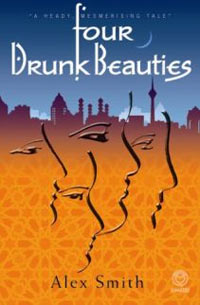
Title: Four Drunk Beauties
Author: Alex Smith
Publisher: Umuzi
ISBN: 9780795702860
Price: R180.00
Four Drunk Beauties is the third novel by award-winning South African author Alex Smith. It relates the story of two men, Kamaal (a Muslim) and Drew (a "Jewish atheist") who were tortured, bound back to back, and left to rot in an Iranian prison.
Smith explores the relationship between the two men as they wait for either rescue or death. In order to keep the extreme horror of their situation at bay, and to bring some mental relief to their suffering, Kamaal tells Drew the wonderful, richly textured, "gaudy" story of the four drunk beauties. The beauties in question are Elvira, a retired South American assassin who has won the New York Mega Millions lottery; Lou, a Senegalese sculptor; Mimi, a Chinese virtuoso cellist; and Adriette, a culinary anthropologist from South Africa. They occupy a world where djinns and marids mingle freely with and interfere in the affairs of humans. Their adventure takes the form of a quest: they must investigate a most unusual murder, recover stolen treasure and do battle with the trained assassins of a cult that is steering events in order to fulfil an ancient prophecy and thus become supreme rulers of the world. The narrative style is a mixture of Manga, Dan Brown and the National Treasure films. After each episode of the adventure the novel cuts back to Kamaal and Drew as they waste away in the prison and start to confront their imminent deaths. The switch from one narrative episode to another is marked by a change in font style, a technique that draws attention to the divide between the two stories. Smith thus manages a careful balance between the farce and frivolity of Kamaal’s story of the beauties and the bleak reality of Kamaal’s and Drew’s last days.
This juxtaposing of two realities is one of many devices that Smith uses to complicate issues of authority, interrogate narrative voice and blur the line between real and imagined as her tale unfolds. The novel starts with an “author’s note” to the reader. Conventionally we view the author’s note as something that pertains to, but is not part of, the narrative itself. This convention raises our expectation: we think that the author’s note must be factual and/or truthful. The narrator of this note is supposedly Smith herself, recounting the events that inspired her novel. These events seem to be a conversation with and real events from the life of one Simorgh Ala-’eddin. The reliability of the narrative is further performed through her meticulous and copious use of footnotes and references throughout the “note”. However, a quick search of the references mentioned in the footnotes delivers no results, and “Simorgh” turns out to be a mythical creature, a raptor, a bird of prey, while "Ala-’eddin" is a variant spelling of "Aladdin". So, from the very beginning the reader should be wary - genre conventions are employed in order to raise reader expectations that are later overthrown.
This cleverly draws attention to the particular processes of story-making, especially since the novel works within the tradition of stories about the power of storytelling, such as Boccaccio’s Decameron, Chaucer’s Canterbury Tales and, most obviously, The Arabian Nights. Furthermore, Kamaal’s story of the four drunk beauties is presented in the form of a guided tour of a travelling museum of famous Persian carpets. Kamaal asks Drew (and the reader) to pretend that he is a student in a town called Shooshtar, and then makes his narrator (at yet another level of narration) a woman, a guide and storyteller, who acts as interpreter of the carpets for the "students of Shooshtar". Kamaal pointedly states that "it is me, acting the part, being Elizabethan about it since there are no real women allowed on this cursed stage”. Again, the reader is reminded that the process of reading or viewing requires a certain suspension of disbelief. We need to pretend that the narrator (and author?) is who he/she says he/she is.
According to the author bio on the back of my copy, Smith is “a writer, traveller, teacher, textile merchant, bookseller and adventurer". It is unclear whether or not this is true, given the novel’s overall attitude towards fiction and truth, especially since this description further strengthens Smith’s position as author by qualifying her with a range of experiences on which to draw. Of course, by the novel’s own logic it doesn’t really matter whether the author bio is “true” or not. Smith ends off her "author’s note" by asking of Simorgh’s tale, "But surely it is fiction?” to which Simorgh replies, "Fiction truer than a thousand and one lies." Then, later, as Kamaal is about to begin his tale, he warns Drew by quoting GK Chesterton: “‘Literature and fiction are two entirely different things. Literature is a luxury; fiction a necessity.’ And we, friend, are most horribly in need of fiction." These two quotes ask of the reader/listener to distinguish between fiction, lie and literature, since our expectations are shaped by the manner in which we understand the relationships between these terms. These are the very expectations that Smith thwarts in her constant shifts and sleights of hand.
In a sense, Smith seems to be challenging notions of category, hierarchy and boundaries. Her story invokes many different modes of “storytelling”. First, there is Kamaal’s structuring of the story of the beauties as a tour of a Persian carpet museum, which also invokes the notion of “weaving” a story. Then there are Lou’s sculptures, Mimi’s music and Adriette’s recipes. By showing how stories are told through these different media and forms, Smith points towards the endless possibilities for other ways of telling.
The effect is a sense of a multilayered world, which is further emphasised by the manner in which Smith includes short phrases from various foreign languages throughout her narrative(s). Although these foreign terms are not translated, many of them are familiar and their meaning can be inferred from context. This gives the sense of an encounter with a familiar yet foreign world, where language can elude us and let us down. Furthermore, all places are made to seem equally foreign. Paris, Manhattan, Tehran, the Orange Free State - in none of these places is space presented as stable, and the reader is never allowed to identify comfortably with any one position.
While one would expect difficulty in reading a novel that seems so intent on thwarting its audience, I found it to be a very gripping read and couldn’t put it down until I had done with it. The wonderful, evocative descriptions, the larger than life characters, the ridiculously outrageous adventures, all the while contrasted with the muted, quiet desperation of Kamaal and Drew’s predicament, make for a real page-turner. A definite must-read.