

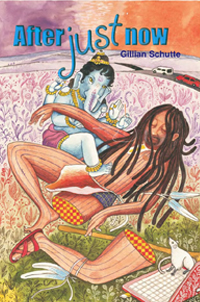
 Title: After just now
Author: Gillian Schutte
Publisher: Ludic Press
Gillian Schutte’s After just now can best be described as a psychic, spiritual and historical travelogue, the non-linear account of a private and shared journey. The reader/ traveller is led through a tangle of personal and socio-historical episodes subsequent to the opening event, which happens “just now” –a calamity in the form of a car crash, followed by a labyrinthine retracing of ideas and experiences back to “just now”. The protagonist, Lila, is a female (and feminist) Odysseus and After just now an account of a lifelong series of distractions which has led her to the now moment of her self-realisation after, by her account, 32 years of blank-mindedness and 11 years of trying to see the wood for the trees. Schutte has woven a surrealistic magic carpet with which she transports us towards and beyond our own life wounds, and our own lived experience of the surrealism that is the history of the Southern African continent.
After just now is also an account of postmodernity, or the experience thereof, signified by a multitude of juxtapositions and layered realities, none of which needs to make logical sense at any given time (whenever this time may be). Thus Kali, Shakti and Ganesh cavort alongside Xhosa warriors, Afrikaner folk and wild beasts which populate Lila’s psyche. The narrator not only projects for us a kaleidoscope of intermingled world cultures, but also travels a spectrum of time zones: historical (back to the 18th century, to the intersection of Lila’s Afrikaner roots and the Xhosa lineage of her husband, Lunga); personal (recounting in diary format the harrowing events of her destabilised life); psychic (portraying slippage between “reality” and out-of-body dream scenes); and spiritual, with orgiastic descriptions of mystic experiences, both Christian and Hindu.
And what could be more postmodern than a tea party with a strident Queen who struggles to silence her own thoughts, a man sporting a self-deconstructing body, a deliciously absurd personification of Dada and Simone de Beauvoir in a tight skirt calling out to Julia Kristeva. Or a bar where you are served by an anachronism, and where the Jive Jive Revolutionaries sing a cappella. “There is no crisis – that is why we need to dance as fast as we can.” Or the impossibility of the existence of any of the above until the reader reads them into being.
Like Lila, flailing her arms at her reflection in the mirror to see whether some invisible force might be blocking her view of the door, the reader is compelled to make sense of it all as (s)he goes along. This short novel uncannily intermingles past and current socio-political events, a cathartic account of personal history and the ecstasy of self-discovery. The denouement is a staggering showdown between the margin and the centre and terminates in the healing ministrations of Tau, the literal and figurative fruit of Lila’s labour. In the end it is Tau, Lila and Lunga’s son, who restores them to wholeness by sewing the 100 strips of Lunga’s shredded body together and by placing Lila’s scattered thoughts back into her skull. Lila may intermittently be running in one place (in between traversing time zones, continents and universes), but she is also travelling the gamut of personal growth and salvation, a journey not measurable in linear space or chronological time, but only open to experience after just now.
After just now can be purchased at Love Books, Bamboo centre, Melville, or ordered at writing@ludicpress.com. R140 including postage.