

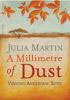
 Title: A Millimetre of Dust
Author: Julia Martin
Publisher: Kwela Books
ISBN: 9780795702631
Pages: 288
With threats of global warming escalating and the end of the world ever more imminent, documentaries such as An Inconvenient Truth, films such as The Day after Tomorrow and books such as Pulitzer Prize-winner Cormac McCarthy's The Road have gained increasing resonance. Finding that the future of the planet and, more significantly, the future of humans on the planet, are less and less certain, it is not surprising that we turn to the past in the hope of understanding the relationship that exists between humans and the earth.
Perhaps, in part, it is this uncertainty about the future which led to Julia Martin's recent publication, A Millimetre of Dust. Difficult to place in terms of genre, it is part travel book, part memoir, and above all, through its visiting of ancestral sites, an exploration of our past, an attempt at discovering that which has been lost, in order to understand "our original mind".
Martin opens with a quote from the author Gary Snyder:
So the question I have been asking myself is: What says "human"? What sucks our lineage into form? It is surely the "mountains and rivers without end" - the whole of this earth on which we find ourselves more or less competently at home.
It is this quote which one must recall while reading A Millimetre of Dust, for it underlines the very thing which Martin is exploring: the notion of the identity of mankind being dependent on our relationship to the earth.
Martin begins her exploration close to home, in the excavation site of Peers Cave, above the dunelands of Fish Hoek in the Western Cape. With a poetic grace that conveys a respect for their meaning, she lists the excavated remains, consisting of bones, artefacts and stone implements. Through her descriptions, the artefacts do not remain artefacts. They are imbued with life, so that for the reader their value is certain, their significance true.
It was during her research on Peers Cave, which had been excavated by the Peers family, that Martin became interested in the excavated remains of the people found in the cave: Who were these people who had lived in the area before the arrival of the white settlers? At the Het Posthuys Museum in Muizenberg, Martin gained some insight into this question. She was shown a sandstone rock with a groove rubbed into it which had originally been used by the local inhabitants for grinding ochre, and which has now been incorporated into the stone floor of the museum. Martin's response to the stone reads as follows:
There are moments in one's life when things suddenly become clear or new. For me that morning, the quiet mark of human work in the sandstone floor was something extraordinary ... [It] became for me a kind of sign, a trace of what was here before.
It is this concern for the traces of what was here before, a deep interest in the past, which formed the impetus behind Martin's visits to further ancestral sites. She was reminded of a site near Kuruman in the Northern Cape called Kathu Townlands which spreads across an area equal to several rugby fields, and which holds the remains of millions of Stone Age tools. The visit to the Northern Cape to see these and other sites form the main focus of A Millimetre of Dust.
In preparation for her visit to the Northern Cape, Martin researched the area's Stone Age sites as well as educating herself about stratigraphy, sedimentology, taphonomy and the science of archaeology. However, Martin's focus is not limited to the geologic; rather, it extends to an interest in narratives about the area, stories of metaphor, told in the voices of people who had inhabited that region. This curiosity led her to the Bleek-Lloyd Archive, which holds a collection of notebooks in which /Xam testimonies were recorded in the late nineteenth century.
What becomes increasingly evident and admirable as one reads A Millimetre of Dust, and particularly so in her discussions of the Bleek-Lloyd Archive, is Martin's sharp ethical conscience. She is a thoughtful and considerate author, bearing in mind always the violence and appropriation that governed the past few hundred years of our history. She comments: "I would like to believe in the possibility of telling stories that are different from the powerful narratives of mastery, conquest and destruction that wielded authority ... and have come to dominate the world." She is careful to state her awareness of the fact that "translation and interpretation are always in a sense betrayal" and consequently that in reading the Bleek-Lloyd Archives one cannot simply consider those voices to be representing a whole way of life. Her own readings of the texts, she explains, cannot but be affected by her own personal reconstruction and interpretation.
Yet Martin relates to the noted-down tales with great sensitivity, and is specifically drawn to the relationship between people and things. This is particularly evident in the recurrent theme she notices: people who were once animals, animals who were once people. In other words, as Martin observes, it is a notion of personhood which is far more inclusive than her own. In fact, the observation regarding the inter-relation between man and nature becomes a sort of refrain in the book, culminating in the realisation that "if stars can be persons and people can be animals, then nature isn't out there, it isn't separate."
In order to visit Kathu Townlands and other sites in the region, Martin travels to the Northern Cape by car with her husband and their two young children, Sophie and Sky. She relates how a 61-year-old woman, Mary Elizabeth Barber, had travelled through this region by ox wagon in 1879. Realising the significance of the masses of stone tools remaining in the Northern Cape, Barber was one of the first people to document them. She wrote her own book on the subject, which, like Martin's, defies genre, encompassing far more than natural history. Martin encounters these Stone Age tools for herself when she and her family finally reach Kathu Townlands. The stone implements litter the area, with an estimated ten to twenty billion artefacts over the whole plain.
Another of the sites Martin visits with her family is Wonderwerk Cave. This cave was inhabited as long ago as the Stone Age and as recently as the 1920s. Since the 1940s archaeologists have been excavating the many layers of earth in the cave in order to find out more about the different people that have lived there over the millennia. Peter Beaumont, one of the archaeologists working at the site, explained to Martin that in those layers of earth a human life span would measure only one millimetre. It is this millimetre which has been taken up by Martin to form part of the title of her book, and it is to this millimetre which I now return. For it is through that millimetre of dust that the insignificance of the individual human in relation to the earth is emphasised. And yet, undeniably, it indicates the remaining presence, no matter how small, of us once we are gone.
From the start of the book Martin searches for that which is lost, and throughout its pages the loss of things through human negligence is evident - from the conical piles of fertiliser which damage engravings and cause alien vegetation to take over, to the flamingos at Kamfersdam which have difficulty breeding due to the treated sewage which runs into the dam, to Martin's own observation upon the family's return to Cape Town:
Back in the city we receive more and more frequent evidence that the present fires of human progress are spreading out of control. The carbon released by this conflagration is accumulating in the atmosphere, and the climate is changing.
Read in this light, a millimetre of dust may well be all that remains of us sooner than we care to think. It is for this reason that Martin's book is one of particular importance. With our future uncertain we must return to the past, we must learn again how to live so that nature is not separate, is not out there, but is here, is us.
A Millimetre of Dust is written with clarity and thought and holds within its pages moments of great beauty. If at times the writing tends towards the overly sentimental and precious, it is redeemed by Martin's ability to take facts and render them poetically, making stones and rocks live for the reader. It is illustrated with photographs from the trip and is well researched with informative endnotes.
This book, with its respect for "the quiet mark of human work" is a moving and important read.