

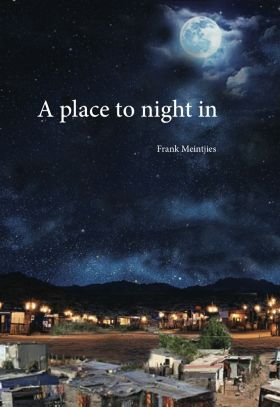
A place to night in by Frank Meintjies (Botsotso Publishing, 2024)
Title: A place to night in
Author: Frank Meintjies
Publisher: Botsotso Publishing (2024)
ISBN: 9781776495252
The notion of home is intimately tied to an individual’s sense of self. As the Canadian-American architect Witold Rybczynski wrote: “This wonderful word, ‘home’, … connotes a physical ‘place’ but also has the more abstract sense of a ‘state of being’.”
This dual meaning of home is certainly a useful way of looking at the new collection of autobiographical poems by Frank Meintjies, A place to night in. The names of various places in South Africa crop up in many of the poems.
In fact, the title of the collection is drawn from a poem called “Home”. It expresses a profound lack of rootedness. “i seek anchors,” it laments, “i want hardy bricks and vines next to a nesting tree/ tall and spreading”. Yet all the poet has, it seems, is “a place to night in”.
........
[T]he title of the collection is drawn from a poem called “Home”.
It expresses a profound lack of rootedness. “i seek anchors,” it laments,
“i want hardy bricks and vines next to a nesting tree/ tall and spreading”.
Yet all the poet has, it seems, is “a place to night in”.
........
Another poem, “New spaces, folds and snarls”, reflects on the writer’s new abode. There is an almost ominous undertone: “my new spaces/ consider me/ observe me”. Even though the new residence is far more spacious than those from his childhood, the poem expresses a feeling of “somewhat unbelonging” and asks plaintively in the last line: “where is home?”
However, this unease does not extend only as far as the boundaries of a house with four walls; it also applies to South Africa as a whole. For example, the poem “Holding pattern” points to discomfort about the inequality that continues to ravage the country. It refers to children who live under bridges “as life goes on in branded coffee shops”. After each of the four stanzas, the poem despairingly repeats the words: “the land the land the land”.
........
Another poem that explores the gulf between people in South Africa is “Poppedorp”. While some onlookers admire the spectacular view of a town from a hill, the poet wryly observes: “what you see below is truer still:/ garden service bakkies wending their way to/ well-kept gardens a dotting of yarded boats/ and on patient plots close to the water’s edge/ new walls as yet unplastered/ rising from builders’ hands”.
........
Another poem that explores the gulf between people in South Africa is “Poppedorp”. While some onlookers admire the spectacular view of a town from a hill, the poet wryly observes: “what you see below is truer still:/ garden service bakkies wending their way to/ well-kept gardens a dotting of yarded boats/ and on patient plots close to the water’s edge/ new walls as yet unplastered/ rising from builders’ hands”.
In “Bits of salt”, the reader is taken on a journey through the southern Cape, Griqualand East and Cape Town, and introduced to “aunt lallie/ who used a plain textbook/ and a ballpoint pen/ in her search/ for the root the source/ the anchor”. The poem ends with a sombre line: “from here unsettled feelings will grow and go/ where I go”.
The theme of displacement – “an existential lack that is perhaps even more fundamental than being without shelter”, according to the British geographer Tim Cresswell – is a recurring one in the collection. In the poem “New spaces, folds and snarls”, for instance, Meintjies points to “The windows walls curtains/ that scab along this skin/ that shadow-sash along the wall”.
Yet, despite this constant state of unsettledness, the poet also finds solace at times in the many places he has traversed in South Africa. In “The bits that constitute me”, for instance, he recalls: “The bits that make me/ have parts of Cato Manor and Raisethorpe/ and Kimberley and Klipspruit West”.
In a similar vein, “Tree of life” is an invitation to “sit down again with me/ on benches chairs crates sagging sofas/ in Woodlands Yeoville Klips[p]ruit-West/ Bridgetown and Overport/ we’ll laugh out madly”.
Other poems that reference places close to the poet’s heart include “That place along the Otto’s Bluff road” (Pietermaritzburg), “Ocean, near Strandfontein” (west coast), “Grey Street” (Durban) and “Dweza sea” (Eastern Cape). And in “Namaqualand wildflower”, for example, the poet celebrates the resilience of a local plant in the arid region. The first stanza notes with pride that: “She draws sustenance/ from dampness in/ the morning air”.
Thus, despite his ambiguous relationship with South Africa, there remains a very deep love for the place and its people. Like Dennis Brutus – that great South African poet of displacement and unhomeliness – Meintjies cannot let go, no matter how much it hurts.
There are also more deeply personal poems in A place to night in. The five-part poem “Tree of life” is perhaps the most explicit of these and starts off with a matter-of-fact introduction: “My names are Frank and Andrew/ I’m eight siblings wide”. Another notable example is an untitled poem about the death of his brother Stanley (“the quiet one is gone”).
But it is not only for its subject matter that Meintjies’s collection deserves attention. His use of language – in particular, the vivid images that he employs – marks him out as a skilful writer. In “Purple flower”, for instance, he refers to an old man “with squirrels for eyebrows”. In “Wentworth”, he describes a cracker as “a red flame/ whipping and twisting in the wind/ a disjointed exclamation mark/ against the sky”.
.......
It is a confident voice that moves easily between past and present, the private and the public. And, at all times, it is restrained, measured; he never shouts.
.......
Meintjies also does not hesitate to engage playfully with the work of those regarded as part of the English literary canon. In contrast with the flowers in Thomas Gray’s “Elegy written in a country churchyard”, for instance, he proclaims in “Namaqualand flower” that “no desert is born to blush unseen”.
And, in “A poem”, Meintjies casually borrows from DH Lawrence’s poem “Snake” to describe how a poem came to him near a small stream outside Pietermaritzburg: “it flicked its tongue/ gave me a brief-long stare/ and slithered away”.
Yet, even though he tacitly acknowledges those who have gone before him, he is clearly intent on forging his own voice. It is a confident voice that moves easily between past and present, the private and the public. And, at all times, it is restrained, measured; he never shouts.
A voice to night in is a most welcome addition to the wealth of lyric poetry in South Africa. It would be to quibble to point to the occasional indulgence and limited access here and there. Meintjies eloquently shows just how versatile and dynamic this self-expressive mode of poetry continues to be.
Also read: