

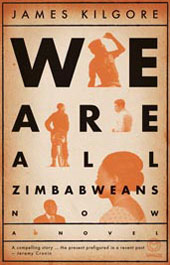
 Title: We Are All Zimbabweans Now
Author: James Kilgore
ISBN: 9781415200711
Publisher: Umuzi
Publication date: 2009
Pages: 272
We read novels for a variety of reasons. The likely reader of Kilgore’s novel may have an interest in African history and current affairs. He or she may be curious to know more about the semi-legendary figure of Josiah Tongogara, military leader of ZANLA and possible rival to Mugabe, who died in a car crash in Zambia in 1979 – just a few days after the Lancaster House conference. His untimely death has spawned a generation of “what if?” commentators and historians (“What if he had lived, would things have been different? Would we have had the gukurahundi? Would we have ended up with the present corrupt ruling elite?” Etc).
The reader may also be fascinated by the figure of the author, James Kilgore, aka John Pape, ex-member of the Symbionese Liberation Army, who found his way to Zimbabwe in the early 1980s (somewhat like his fictional counterpart, the earnest doctoral student from Wisconsin, Ben Dabney). People in Cape Town with an interest in education and labour matters may know Pape as a respected researcher and teacher; his colleagues at ILRIG started a John Pape Support Fund after his arrest in 2002 (and subsequent trial and incarceration in the United States).
The book was written, very laboriously, in prison and went through a number of drafts: its mere appearance is testimony to the resilience and determination of the author.
Fascinating though all this may be, ultimately the novel has to stand on its own two feet. Is it an interesting and compelling narrative? And must one keep judging it by how closely it corresponds to historical realities?
To answer the second question first: the novel is convincingly set in post-independence Harare in the early 1980s, during the first heady post-independence days, when Mugabe was widely admired. (Of course he still is, in some quarters.) It registers the responses of its protagonist, Ben Dabney, to what is initially a strange and unfamiliar environment. Although Dabney may not closely resemble Kilgore, they do seem to share a political radicalism and an interest in history. The strange disparities in post-1980 Zimbabwean society come through clearly, as do Dabney’s sometimes floundering attempts to acculturate. With its attention to detail, it meets the customary specifications for realist fiction:
A few doors from the tobacconist lies a sidewalk café attached to a Wimpy hamburger bar. A curious glance reveals white women drinking tea and cutting toasted cheese sandwiches into bite-sized pieces before delicately forking them into their mouths. Black waiters scurry about carrying red plastic trays. They respond to the curt orders of their customers as if the liberation war had never happened. (21)
Dabney learns how to drink Castle lager (lots of it) and how to eat sadza, and picks up a smattering of Shona. He also encounters a range of Zimbabweans with struggle connections, from Cabinet ministers (Titus Mawere, Pius Manyeche) to ex-guerilla fighters, like Florence Matshaka (“Comrade Chokie“) with whom he develops a close relationship (the nearest he comes to commitment).
Dabney starts with various preconceptions, some of which may (now) strike the reader as naïve or idealistic. (One has to resist – or at least be aware of – the temptation to read the novel in the light of one’s subsequent knowledge of Mugabe and ZANU-PF and their brutal regime.) He tells us up front that Mugabe is his hero (“more forgiving than Mother Theresa, as single-minded as Martin Luther King or the Dalai Lama”) – although at the same time he claims to “choose [his] heroes carefully”. How carefully did he (or perhaps we?) choose Mugabe in what seemed to be “the dawn of a new era”?
Dabney goes to Zimbabwe to “chase [his] dream” and (rather hubristically) to write “the definitive history” of that country’s struggle for liberation. The novel traces the process by which he (gradually) acquires disillusionment – a process which many readers of the novel may be able to relate to. The precipitating event is his visit to a school in rural Matabeleland: after what he sees there, Dabney can no longer say he didn’t know.
Interwoven in this narrative is his commitment to history (“History remains my obsession,” he tells us). This leads him to grapple with various questions: Can history be “definitive”, or is it always partial (in both senses of the word)? Can it uncover “the truth” (if there is such a thing)? And what kind of history should he be writing: history from above, from the perspective of the ruling elite, or history from below, built on the testimony of ordinary people who lost limbs (like Florence) or children and family members (like Mrs Taruvinga, and countless others).
The novel is also a quest narrative: these issues are sharply focused by the search for the truth about the life and death of Josiah Tongogara (thinly disguised as Elias Tichasara) – the charismatic leader whose passing (in an “accident” in Zambia) helped to cement Mugabe’s grip on power. Is Tichasara/Tongogara a “hero of the struggle”, a leader one can place on a pedestal – or would one simply be doing to him what has been done to Mugabe? Could the presence or absence of this one man have altered the course of history? In the end, Dabney gives up his attempt, defeated not only by the complexity of the task, but also by its possible real-life consequences for himself and for Florence (whose son, Elias, turns out – rather improbably - to be the love-child of Tichasara/Tongogara). One of the lessons Dabney has to absorb is that in Zimbabwe “history is not an academic exercise” – it can be a matter of life or death.
Dabney himself remains a somewhat enigmatic figure, more acted on than acting. It takes him a long time to venture into Harare’s “high-density suburbs” and even longer to venture into the rural countryside. His central human commitment – to Florence – seems as much a narrative convenience as anything else. His most convincingly realised relationship is, in fact, with her son Elias, for whom he becomes a kind of surrogate father (ironically, since the real father is Tichasara). There is little attempt to capture interiority in any depth: after witnessing the assault by members of the 5th Brigade on Moyo, the headmaster of a school in Matabeleland, he continues to cling to the naïve belief that “Mugabe can’t know this is happening.” His actual interview with Mugabe (potentially the climax of the book) is confused and inconclusive, and never gets behind the rhetoric. One is left asking (and this is no doubt intentional), “Who is Mugabe?” Perhaps Dabney is simply “in too deep”. In the end, he returns to the relative safety of Milwaukee to write his book – The Quiet Heroes of Liberation – and reconnect with his daughter, Hilary. Perhaps he will be a better historian for all he has lived through.
The strength of the novel lies in the way in which these issues are woven into a credible narrative. Set in the early post-independence years, it shows how the seeds of what was to come were already clearly present, even then, if one cared to look. The title contains a warning for all those who might be tempted to subscribe to simplistic, triumphalist struggle narratives: we are all potentially contaminated by our complicity with the unfolding disaster that is Zimbabwe. We are invited to think about where the uncritical acceptance of an officially endorsed struggle history (complete with heroes and villains) might lead us – in this country and elsewhere.