

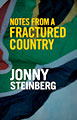
 Title: Notes from a Fractured Country: Selected Journalism
Author: Jonny Steinberg
Publisher: Jonathan Ball Publishers
ISBN: 9781868422937
Pages: 240
Farm murders in KwaZulu-Natal, the prison gangs of Pollsmoor, AIDS in the Eastern Cape – nobody can accuse Jonny Steinberg of shying away from all that is most disturbing in South Africa. In Midlands (2002), The Number (2004) and the forthcoming Three-Letter Plague, this formidably intelligent and prolific journalist has unleashed upon the unsuspecting public a body of work where the difficulty of the subject matter is matched by exhaustive research, and all of it driven, one senses, by a distinctly personal sense of mission. Notes from a Fractured Country collects his fortnightly columns for Business Day over the past five years, extending the range of his enquiries to the police service, the Constitutional Court, violent crime and Iraq, yet at least allowing one to take a deep breath before and after each of the short nuggets.
No ordinary doom-monger, Steinberg combines a political scientist's command of abstruse statistics with a keen eye for the everyday. In a column asking, "Is your car guard's granny South African?" he ponders why local car guards put in seven or eight hours a day while their foreign counterparts (largely refugees or asylum seekers from the rest of Africa) work the streets around the clock. By way of indirect explanation he cites a survey by Princeton economists which sampled South African households and found "a sharp drop in the labour force participation of prime age men when the women of the household reach 60, and the elder men 65, the respective ages of pension eligibility". Unemployed South Africans who stay connected to their extended families, he speculates, are spared the choice between guarding cars at 2 am and hunger: "Perhaps a critical mass of DRC refugees does face that choice. Perhaps that is why the man guiding you out of your parking space after dinner has a foreign accent."
The rare mixture of hard-nosed economics and human empathy is evident too in a discussion of welfare grants. Steinberg berates welfare advocates who flatly deny the charge that expanding social grants discourages the poor from working. Of course many people stop working when they have access to grant money; to claim otherwise is ludicrous, morally confused and "the discursive equivalent of suicide" which gives the opposite side of the debate more ammunition. In a passage evidently drawn from his eagerly awaited book on AIDS, the author gives a personal account of a grim subculture of labourers in Lusikisiki known as the rickshaws, a group of HIV positive men who have been thrown out of their homes and now make a living ferrying heavy bags from taxis to spaza shops. When several of them do not appear for work one day, Steinberg is told that it is because their HIV disability grants have come through.
In this and other "ghastly little corner[s] of the labour market" it is obvious that if people can survive without working, they will stay at home. Yet as Steinberg remarks, the real question (and one which is rare and refreshing to see in the pages of Business Day) is: So what? The supply of casual labour would fall, and its cost would rise: "[Y]ou and I would pay a little more for supermarket bread. I'd hazard a guess that the price of Free State asparagus and Boland Chardonnay would rise a little too." Human well-being, he remarks, cannot be measured by jobs alone, and surely "it will be a good day when chronically ill young men do not need to carry beer on their backs in order to put food in their stomachs." Drawing on the work of crime analyst Antony Altbeker – a colleague who has provided pathbreaking insights into the economies of desperation on the edge of the formal sector – Steinberg points to the precipitous fall in South Africa's murder rate which coincided exactly with steep increases in grant payments: "if the price we must pay is a decline in the supply of cheap, nasty labour, then so be it."
Mass unemployment, pandemics, refugees in their millions - in the face of such problems, it is all too easy to slip from denial to fatalism, and all too difficult to steer a course between glib amnesia about South Africa's violent past and an unproductive fixation which invokes it to explain all the problems of the present. Steinberg's strength is to combine a deep awareness of 20th-century South African history with an openness to a globalised future, all of it delivered in a level-headed prose which never sacrifices the complexity of the socio-economic data for journalistic flourish.
And this, perhaps, is the difference between him and South Africa's other, more flamboyant narrative journalist, Rian Malan, who by his own admission has several times donned his pundit hat and predicted an apocalypse which never came to pass. The depiction of the rural Msinga in My Traitor's Heart has much in common with Midlands, but while Malan's prose gradually becomes weighted with brooding scenic description and existential angst, Steinberg manages to avoid entirely that strain of white writing which uses darkest Africa as a sounding board for its troubled soul. The beloved country may well be lovely beyond any singing of it, but it is also a place of "cruel politics, each new scene a micro-world of stubborn memories and pernicious games":
Beginning with a clear-eyed view of the South African landscape, and going to great lengths to seek out the stories of the people who inhabit it, Steinberg avoids entirely the cloying, patronisingly disappointed tone of many a newspaper commentator, or the suburban "white whines" which (as a recent sketch show at the Market Theatre had it) once again constitute a growing export to Australia and New Zealand.
The advantage of having all the columns in book format is that one is able to appreciate the comparative sweep of the author's enquiries, a wide-angle perspective generated by the sense that southern Africa – an exaggerated, spatially distorted amalgam of First and Developing worlds - is a microcosm of "global apartheid" and a laboratory for competing economic doctrines of the 21st century. At the same time, Steinberg avoids the trap of seeing South Africa as a land apart, or a special case deserving of insular, undivided attention. In the "Abroad" section of his Notes we are taken to Manhattan and Hiroshima to consider the commemoration of mass historical trauma, to Buenos Aires in the wake of Argentina's financial crash, and to Bogotá, "less a place than a sigh of relief" amongst the SAPS top brass in that it keeps Johannesburg off the number one spot on Interpol's list of the most violent cities on the planet.
Turning to Australia, he examines how Ned Kelly has been reclaimed as a folk hero, and compares him with South Africa's lesser known but no less remarkable bandit leaders, Nongoloza and his Ninevehites, progenitors of the prison mythology which Steinberg detailed with such horrified fascination in The Number. Walking through Pollsmoor on the eve of the Iraq invasion, the author remarks on the combination of anti-imperial graffiti and craven imitation of American culture. It is symptomatic of a convoluted love-hate relationship that fills in the vacuum where local histories and identities should be, and which predicts that the Bush administration's monolithic crusade to equate America with freedom was always doomed to fail. In the meantime we are treated to an earnest analysis of gangster rap:
This is true no doubt, but ... Doggy Dog? Surely no one would refer to the ghetto fabulous Snoop (aka The Doggfather) like that, no matter what their gang affiliation. Still, if this is the only, tiny foot that Steinberg puts wrong in such a wide-ranging collection, that is something. And in any case he is more than ready to acknowledge the problems inherent in his brand of underworld anthropology: the difficult dynamics of the interview situation, a problem in translation, a failure in communication.
In an article of November 2006 he describes a heated exchange with elderly men in the Eastern Cape who voice their suspicions about foreign antiretrovirals. One of them picks up a mealie cob and explains: "This is ours. If a clever African scientist made an AIDS remedy out of this, I would trust it." Obviously, having read Jared Diamond's Guns, Germs and Steel, Steinberg counters that the staple crop is no more African than antiretrovirals; the man's forebears had started to use maize because it was more productive than sorghum and required less labour to farm:
"You are just trying to be clever," he snapped, waving the mealie cob
dismissively. "What I am saying is that one must be very careful before accepting offerings of others."
This vexed encounter between the local and global is replayed several times in the book, yet placed in a telling historical context. When second-hand computers from a British charity are rejected by the National Education Department, Steinberg traces this act of bruised pride back to the "obsession with technological self-sufficiency" and "fierce technological nativism" shown by the apartheid government. The grain farming of Mesopotamia, the Scottish Enlightenment, the Asian tiger economies - each is invoked to show that "everyone who has ever triumphed has done so by making good with hand-me-downs", that progress comes from insouciance, levity and confidence in government, rather than from brittle pride and a sense of besiegement.
Inevitably, discussion turns to the most embattled and besieged standpoint of them all: Thabo Mbeki's AIDS policy. In a dense piece of June 2007, Steinberg discusses a book by a French anthropologist which offers an exceptionally generous, empathetic attempt to understand the President (and here he might as well be referring to the biography by his friend Mark Gevisser). Both imply that Mbeki is no eccentric dissident; rather, "he gives voice to an aggrieved and quintessentially African experience, one shared by millions." As with orthodox, colonially blinkered medical histories of tuberculosis in the 20th century, the international discussion on AIDS is yet another discourse on Africans and illness that remains "silent about poverty, about political economy, about the modern environmental conditions that have been killing Africans for generations".
At this juncture Steinberg makes the surprising move of invoking Lucy Lurie in JM Coetzee's Disgrace, a rape victim who "comes to see the attack on her as a kind of historical reparation". In her decision to remain on her Eastern Cape smallholding (we are told), Coetzee conveys Lucy's subtle racism, portraying someone who is "fatalistic about the future because her expectations of black-ruled South Africa are terribly low. Trying desperately to understand her attacker, she condemns him." So too, in their ostensible generosity, Mbeki's apologists end up condemning African nationalism by implying that it was destined to get the aetiology of AIDS horribly wrong:
In the meantime, we should beware generous anthropologies of African mistakes.
No doubt Coetzee's novel was read in these stark, unforgiving terms by many South Africans, yet it is strange to see such an interpretation cited as cultural orthodoxy. For if anyone is the fatalist, it is Lucy's father, the unreconstructed male presence who filters the narrative and sees events in abstract terms which are of no help to his daughter: "It was history speaking through them, a history of wrong." Moreover, by the end of the book he has undergone a profound change, while her decision to remain on the land is surely something more opaque and open-ended than this paraphrase suggests.
Perhaps the clarity of Steinberg's prose and the range of his enquiry demand such curt readings of novels, but the privilege of literature is to remain naggingly unfinished, opening out into a world of human relations which extend beyond the reach of political science.
In any case, the last section of Notes provides a more acute gloss on the troubled rural world of Disgrace. In the columns grouped under "Countryside", Steinberg describes the "drifters, not yet properly urban, no longer properly rural" who journey back to their ancestral homes incessantly during the course of their failed adult lives. Here, perhaps, is an acute diagnosis of the perpetrators whom Lucy sees still hanging around the district after her ordeal, and whom her neighbour Petrus has no choice but to support. And at a time when the planet's urban population has just outstripped that of the countryside, the particularly South African social dislocation evoked in the last paragraphs takes on a grimly global resonance: