

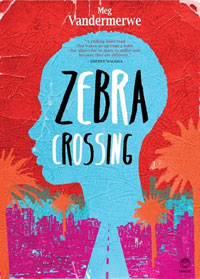
 Titel: Zebra Crossing
Skrywer: Meg Vandermerwe
ISBN: 9781415203927
Koop Zebra Crossing by Kalahari.com.
Meaning in its dictionary form “the dislike of foreigners” and “racial intolerance”, the word xenophobia surged indelibly, brutally through the socio-political circuits of South Africa and into our psychically wounded body politic in 2008. Since those torrid times we have, of course, had to witness the massacre of Marikana, while the plight of refugees and asylum seekers crossing our borders and their safety seem to have been usurped or at least overshadowed by questions around the legality and authority of conduct by the SAPS.
Concurrently, as a lecturer in creative writing and English literature at the University of the Western Cape, Meg Vandermerwe would no doubt have followed the increasing awareness of “otherness” manifesting in recent times, not only on the street but in newspapers, magazines, talk shows and academic discourse and study. After her well-received collection of short stories, This Place I Call Home, was published in 2013, Vandermerwe has now produced Zebra Crossing, a novel arguably inspired by the xenophobic attacks that took place in this country around the time that the Soccer World Cup was hosted in 2010.
Without unqualified exultation it would be fair to say that Zebra Crossing is one of the very best works of socially conscious fiction produced in 2013, one that provides ample evidence of tremendous literary ability and a fine understanding of form.
Framed by an illuminating prologue and a melancholic epilogue, Zebra Crossing is narrated with first-person candour by Chipo Nyamubaya, a young Zimbabwean refugee who also happens to be female and suffering from albinism. The novel’s prologue establishes a focus on border crossings, memory and the torsions of power that will linger as the narrative progresses.
The following framing recollection sees Chipo thinking back to moments in class as a seven-year-old in Zimbabwe, while the headmaster speaks of colonialism and “greedy foreigners” carving up the African land:
If I were in that classroom today, I would raise my hand and answer: A border is a place where barbed wire and high fences black your way. It is where you are not wanted, but where you must nonetheless go. It is where you must wait, terrified as you are, for the right moment to take your chance and dance with fate, while high above you in the starlit sky, the migrating swallows pass back and forth, unhindered. A border is where you must say goodbye. You cannot afford to turn and look back. The past is the past. That is what your brother says. Borders rhyme with orders. You follow your brother’s orders. You have no choice. Time to go forward, he says. To look forward. A border is where you swap home for hope.
Chipo and her brother George, before setting off to South Africa to meet their cousins David and Peter, live with their loving mother, a fanatical Man United fan who operated a successful drinking tavern delightfully named Old Trafford, dreaming of one day meeting her heroes like David Beckham before he transferred to Real Madrid. Chipo’s father left at birth once he’d witnessed her “foreign pink form”, an omen that she is “not like other children”. This is the result of Grace’s affair with a white man. Before Chipo and George are fully grown, their mother would pass away from terrible illness, and the siblings will earn their keep will menial jobs. While in Zimbabwe, Chipo realises that her brother offers her protection in exchange for her obedience to him. Others in Zimbabwe might call her “peeled potato”, “monkey” or “sope”; her peers “throw insults at her back like rotten eggs”. To George she is “Tortoise”, “Little Sister”.
Ridden with increasing doubt as to her place in the world and her future prospects, plagued by insecurity and self-loathing, but remaining hopeful, Chipo is to be rudely awakened during her time spent in South Africa. She lives with George, David and Peter in a small flat in President’s Heights. A fifth party, a tailor and widower, Jean-Paul, lives with them and pays the lion’s share of the rent, while another foreign national, Jeremiah, rounds out the cast of main characters.
Rather than being a catalogue of horrors experienced by foreign nationals at the hands of South Africans, the body of the narrative charts the way that this group of foreign nationals try to find their feet in Cape Town, rather than seeking to remake or find a new home.
The novel’s final third is an increasingly agonising read, with Chipo becoming ensnared in a money-making scam based on bets for the results of the World Cup with the seedy Doctor Ongani, who relentlessly exploits her albinism and the superstitions attached to her condition. Right up until the epilogue one is left turning the pages, anxiously awaiting to encounter Chipo’s fate.
A closer reading of the novel must start with the apposite and multivalent title, Zebra Crossing. After Chipo has her hair braided, George says that she looks like a zebra: the bottom and roots are blonde, the braids black.
Apart from the more obvious dimensions of a racial binary between black and white and the notion of the black race as possibly “animal”, what comes to mind for this writer is the ironic, de-essentialised racial “cover” or “screen” projected on to Chipo as albino/zebra: for all practical purposes, she is deemed neither black nor white. She is the ultimate outsider, never an “insider” to any cultural grouping. She is both trapped within her albinism and trapped outside it, always looking, never belonging. The conceit of albinism thus doubles as a kind of self-reflexive identity marker bleeding on to the way that a foreign national is deemed to be “other”, “outsider”, “makwerekwere”.
Vandermerwe seems to imply, quite rightly so, that those different from ourselves must be doomed to an existence of continual “crossing”, always uprooted, threatened, unmoored. Another dimension to be found here is the novel’s unpacking of what it means to “cross” someone, to do wrong to the other, and having various crosses to bear. This is augmented by various Biblical allusions and the Biblical names many characters have.
While reading many passages I thought of the ways that Vandermerwe’s insights might resonate with those from K Sello Duiker’s Thirteen Cents, a novel featuring a similarly unusual protagonist and narrative voice.
The following passage is also rather similar in tone and feel to what one encounters in Duiker’s novel:
It is supposed to be the start of summer, but today there is only rain. It falls light like hospital gauze. Cape Town’s rain-darkened sky can be all the shades of grey. Sometimes like wood smoke, sometimes dark as concrete. At other times it matches the pigeons that peck at Long Street’s pavements, their feathers congealed with gurgling drain water. But now it is almost white.
Make no mistake, the narrative is harrowing. At one point we are told: “Refugees rhymes with fleas. And fleas must have their heads squeezed off.” Various other mnemonics as voices by Chipo come into play, increasingly macabre, increasingly pointed.
In another telling reflective conceit, Chipo’s poor eyesight and general sensitivity to light render her able to gradually see the truth of her situation, to become enlightened as to the plight of others similarly marginalised during the period where she must function without her spectacles, which are broken close to the novel’s end by her insensitive brother. The more Chipo “sees”, the darker her view of the world, one would argue. But this is not the case.
In an epilogue of astounding lyricism and haunting melancholia, Vandermerwe allows Chipo to conclude her own story, a move that lends Zebra Crossing the air of an elegy, a kind of vigil for all those that were left unheard, their stories silenced, and their bodies burned.
Chipo learns that certain nationalities end up doing certain jobs, that Home Affairs serves certain kinds of people on certain days of the week; the desire for some form of community and connection is heightened away from home.
While Chipo is a protagonist reminiscent of Khambili from Chimamanda Ngozi Adichie’s Purple Hibiscus, sensitive, gradually disabused of various beliefs and notions, the rest of the main characters are also well drawn and memorable. George is the brutish foil to the gentle, kind David, while his twin, Peter, five minutes his junior, is juvenile and cruel.
While David sends parcels and money back home to his family, Peter sends nothing. Jeremiah and David have a secret homosexual relationship that they hide from their housemates, a crucial addition to the novel’s inclusive aesthetic.
Readers are likely to find the pedant Jeremiah interesting, and the relationship between David and Jeremiah touching and authentic, but the most remarkable character portrait is arguably reserved for Jean-Paul. Haunted by his wife’s death, in love with colour and fabric and one to drink only coffee made from Rwandan beans, he is ultimately one of the few characters, along with David, that has Chipo’s best interests at heart.
One need only consider the following passage to gain insight into the socio-political dimension and heft of the novel’s storytelling, its moral alertness and vigilance:
Fear is a sharp word. It makes your tongue bleed. Anger is sour and fiery. Like acid indigestion. Hatred. Hatred is a word that gets stuck in your throat. Xenophobia. Xenophobia is a long word. Complicated, arrogant. It thinks it is smarter than other words. It is a bully. Anxiety is a terrible word. It is the ground turning to quicksand beneath you.
Ultimately, the “smoke of May 2008” lays the opaque groundwork for Vandermerwe’s electrifying Zebra Crossing. As the novel cuts back and forth between present, past and future, offering kaleidoscopic impressions and considerable scope, we are left to ponder if everything is also what it is not. It is such a reflective, reflexive way of imagining that reveals how the name Chipo, “gift” in Zimbabwe, also sounds like “chipko”, the Shona word for “ghost”.
Teken in op LitNet se gratis weeklikse nuusbrief. | Sign up for LitNet’s free weekly newsletter.