

 |
So ongeveer 400m van die kus by Franskraal is daar 'n eiland van ongeveer 80m by 40m, te klein om 'n naam op kaarte te hê, maar groot genoeg dat baie trekduikers daarop broei. Oorkant lê 'n klein uitstulping wat nie deel van die dorp uitmaak nie, maar nogtans sy oudste gebou bevat: die Eilandhuisie, tans die tuiste van die Strandveld Museum. Die stuk see tussenin is vol rotse, party taamlik groot, wat permanent bo die water uitsteek.
Vanoggend sit die rotse naby die Eilandhuisie swart van die trekduikers, minstens 'n duisend van hulle. In die water is daar ook baie, besig om gedurig uit te fladder tot hulle so 'n meter hoog is, dan vinnig en doelgerig terug te plons. Dit is nie so 'n ongewone gesig op Franskraal dat almal uit hulle huise storm om te kom kyk nie, maar die meeste verbygaande motoriste hou darem vir 'n paar minute stil en enkele kameras word uitgehaal.
Trekduikers (Phalacrocorax capensis = die kaalkopkraai van die Kaap) is deesdae op die Rooilys as byna-bedreigde spesie. Daar is nog steeds ongeveer 131 000 van hulle in Suid-Afrika, maar in 1978 was daar 364 000. Die afname beloop gemiddeld 3% per jaar, minder as inflasie, maar dit hou net aan en aan soos wat mense meer en meer van die duikers se enigste kos uitvang.
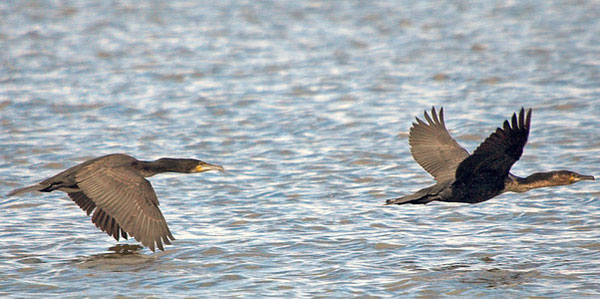
Gewoonlik sien mens trekduikers aan die vlieg in sulke lang strepe parallel met die kus; dit neem maklik 'n uur of meer vir 'n swerm om verby te kom. Hulle soek skole vis naby die kus.
Trekduikers weet dat as hulle net lank genoeg aanhou met soek, sal hulle iets kry, genoeg vir die hele swerm. Dit is Vlak 1 van weet: doodgewone, onselfbewuste weet.
Vlak 2 van weet is selfbewuste weet, "weet dat jy weet". Vir die mens is dit die alledaagse soort weet, die eienskap wat ons spesie van ander onderskei (Homo sapiens = die mens wat beproef). Ons is bewus van ons kennis en wil dit instinktief met mense om ons deel: "Het jy geweet dat …?"
Vlak 3 van weet is wetenskap, "weet dat jy weet en hoekom jy weet". Kennis alleen is nie genoeg nie. 'n Wetenskaplike artikel gee altyd 'n rede vir elke bewering, selfs al is daardie rede dalk net 'n verwysing na 'n publikasie waar daardie bewering gestaaf word.
Bybelkunde word byvoorbeeld op Vlak 3 beoefen. As jy Nestle–Aland se Griekse Nuwe Testament oopmaak, sien jy die voetnotas vat meer plek as die teks. Vir elke keuse tussen variasies is daar 'n verwysing, vir elke bron, selfs skrapse flentertjies papirus, is daar 'n kode.
Ook teologie word op Vlak 3 beoefen. Dis hoekom predikante in die susterkerke ses jaar op universiteit moet sit. Sedert die Hervorming is elke teoloog wat sy sout werd is, net so nougeset as enige natuurwetenskaplike in die aanhaling van bronne en die betoog van redes hoekom 'n spesifieke siening gehuldig word.
Maar geloof self word net op Vlak 2 beoefen: Weet dat jy weet, maar nie hoekom nie. Hebreërs 11 stel dit besonder duidelik.
Die geloof dan is 'n vaste vertroue op die dinge wat ons hoop, 'n bewys van die dinge wat ons nie sien nie.
Wetenskaplikes is nie hiermee tevrede nie. Hulle wil geloof na Vlak 3 neem. Teoloë en kerke wat hulle dit nie gun nie, dryf hulle tot militante ateïsme.
Die mistiek-model sê dat die vermoë om God se stem te hoor 'n talent soortgelyk aan musikaliteit is. Met behulp daarvan kan ons 'n rasionele basis vir geloof opstel.
Soos in die wetenskap is daar drie moontlike redes om te glo: Waarneming, sitasie en teorie.
Waarneming
'n Mistikus ervaar 'n openbaring, 'n visioen, 'n gesig, 'n droom. Die skouspelagtigste voorbeeld hiervan is Paulus se Damaskus-ervaring, maar dit kan ook 'n meer geleidelike proses wees. Dit is onherhaalbaar en persoonlik, nes musiektalent. Mistiek kom in die meeste religieë voor, selfs dié wat nie God as 'n verklaring daarvoor invoer nie, soos die Boeddhisme, met sy subtiele skakerings van satori, bodhi, prajna, ensovoorts.
Sitasie
'n Begaafde mistikus, soos Siddhartha Gautama, Paulus en Muhammad (in chronologiese volgorde), se getuienis word gebruik om 'n minder geseënde mens se eie geloof op te baseer. Mense stroom om charismatiese figure te sien optree. Die pastoor van 'n eenman-kerk is soos 'n idool van popmusiek; 'n magtige saamtrek in 'n stadion of op 'n koppie, soos 'n massakonsert.
Teorie
Verskillende mistici se openbarings word saamgegooi, en deur 'n proses van induksie kom daar 'n enkele konsep uit, min of meer soos wat 'n teoretiese fisikus uit verskillende waarnemings 'n enkele natuurwet aflei. Dit word dan dogma: 'n onbevraagtekenbare gegewe waaruit verdere afleidings deur suiwer logika gemaak mag word. Dit stem ooreen met musiekteorie.
Deur 'n wetenskaplike bril lyk die dogma van Biblisme, dat die Bybel self die enigste voorskrif tot geloof is, nie basies genoeg nie. Die Bybel is nie homogeen nie, en kan gebruik word om byna enigiets te onderskryf. Soos Shakespeare dit in Die Koopman van Venisië stel: Die duiwel haal die Skrif aan vir sy doel.
Biblisme berus op talle verskuilde aannames.
- Elke passasie van elke soort, selfs roetes deur die woestyn, inventarisse van voorwerpe en naamlyste van krygers, is ewe waardevol.
- Op 'n sekere stadium is die teks eens en vir altyd vasgestel, en daaroor mag nie geredekawel word nie.
- Elke mistikus daarin vermeld se ervarings is ewe besield as enige van die ander; elke mistikus nie daarin vermeld nie, is geen aandag werd nie.
- Die spesifieke seleksie van tekste is net so gesaghebbend soos die mistici se eie openbarings.
- Selfs die redaksionele ingrepe — byvoeging, samevoeging, wysiging, weglating — is geseënd.
Vir Vlak 3 moet 'n mens die dogmas ontbondel. Dit is belangrik om van 'n spesifieke dogma te weet wanneer en deur watter groep mense dit tot daardie status verhef is; op grond waarvan die besluit gemaak is; watter oorspronklike mistici die waarnemings gemaak het waarop dit gebaseer is.
Daar moet erken word dat dogmas 'n gedurige verandering selfs binne Bybelse tye ondergaan het. Die verskillende dele van die Bybel weerspieël elk die teologiese strominge van sy tyd. Byvoorbeeld: tydens die Ballingskap het sekere Babiloniese invloede op Joodse teologie ingewerk. Is hulle regtig versoenbaar met ouer dogmas? Is hulle invloed op latere dogmas regtig heilsaam?
Vyfhonderd jaar gelede het die Hervormers die aanvaarde dogmas grondig hersien. Maar ons moet besef dat dit nie in die gees van hervorming staan om een orde vir tyd en ewigheid deur 'n ander vervang te vervang nie.
Anders bestaan daar die gevaar dat geloof selfs tot Vlak 1 verlaag word. Dan word ons soos trekduikers wat net met die swerm saamvlieg en gaan sit waar die vis daardie dag te vinde is.
Kommentaar
Almal baat by musiektalent. Jammer Dirk verduidelik nie hoe die mensdom baat by die insigte (illusies ?) van die misitici nie. Ten beste skyn hy die nadelige van die heilige dogmas te wil beperk deur vinniger hersien te bepleit.
Baie dankie vir jou artikel. Ek pos hiermee 'n artikel wat reeds in 1995 verskyn het onder die opskrif:
"How Do We Know What We Know? by Lane P. Lester, Ph.D. Creation Research Society Quarterly 32(2) 1995 http://www.creationresearch.org/crsq/articles/32/32_2a.html" as nog 'n siening oor die saak.
Each one of us knows lots of things. We know our name. We know our address. We know the sum of two plus two. We know which political party is best for the country... hmm. It seems that some people know things that are the opposite from what other people know. For example, many people know that evolution is the correct explanation for the history of life. But many other people know that creation is the correct explanation. How is it possible for different people to know different things? What does it mean to know something?
Perhaps we could agree that to know something is to be personally convinced of its truth. Notice the personal element here: knowing something doesn't make it true; it only means that we consider it to be true. The fact that some people know things that are the opposite from what other people know means that some people know things that are false!
Whether true or false, how do we come to know things? There are really only two ways: personal experience or someone tells us.
PERSONAL EXPERIENCE
Each of us knows many things we learned on our own.
Let me give you some examples of mine: Stubbing your toe is painful. Knowledge like this we pick up early in life.
Rolling through a stop sign will get you a traffic ticket.
Actually, I had to experience this twice before I really knew it.
Accepting Christ provides benefits in this life. I believe it was a former pastor of mine who pointed out that one of the benefits is that you associate with a better class of people! More seriously, I have the benefit of seeing my prayers answered.
Passing electricity through water produces both hydrogen and oxygen gases. Perhaps in some science class, you also performed this classic experiment with a battery, wires, and test tubes.
SOMEONE TELLS US
If you know something and you didn't experience it yourself, someone had to tell you.
Here are a few examples:
The word "cat" is spelled "c-a-t."
For the most part, education involves someone telling you things, either orally or in print.
The speed limit on the expressway is 55 m.p.h. If you don't learn this from the printed sign, a policeman will be glad to explain it to you both orally and in print.
Accepting Christ gives me eternal life. I haven't experienced the full truth of this yet, but God has told me in the Bible that it is so.
Hydrogen is the smallest element. You and I lack the equipment and knowledge to determine the truth of this scientific fact, so we have to learn it from a science book.
CAN YOU TRUST YOUR OWN EYES?
In general, we are more willing to believe what we learn from personal experience than what someone tells us. But can we always believe what personal experience tells us? Would anything make you doubt the evidence of your senses? Imagine that you are walking along a busy sidewalk that fronts a large park. Out in the park you see a flying saucer descend and land. Would you immediately begin exclaiming to others about your discovery? I think I would first glance around and see if anyone else was experiencing the same thing. On the other hand, if the landing craft were a helicopter, there would be no reason to doubt what my eyes had told me.
The general principle here is that we expect to see the commonplace and not the unusual. Indeed, our senses may even lie to us based on what we expect to be true. A good example of this comes from the life of Jesus when he cries out, "Father, glorify your name! Then a voice came from heaven, 'I have glorified it, and will glorify it again.' The crowd that was there and heard it said it had thundered; others said an angel had spoken to him." (John 12:28-29 NIV)
WHOM DO YOU BELIEVE?
What about the things we know because someone has told us? Remember that we're defining "know" as "being personally convinced of the truth of something." Not everything that we're told is the truth, is it? What is it that makes you more inclined to believe some people than others, to add what they say to the things you know?
Here's a short list of pairs of individuals who tell us things:
casual acquaintances and best friends
philosophy professors and science professors
newspaper reporters and television reporters - pastors and God (Bible)
What determines how readily you would be to believe each of the above persons when they tell you something is true? Would you be more likely to believe one member rather than another in each of the above pairs? How long you've known the person might be one factor, and you would probably be more likely to believe your best friend than you would a casual acquaintance. In my case, there would be a problem because, when I was growing up, my best friend was a compulsive liar. A really nice guy, mind you, but he had a problem with the truth.
What about those two professors? If a science professor told you something about science, and the philosophy prof told you the opposite, you'd be more likely to believe the scientist, wouldn't you? So here's another factor in our willingness to believe what we're told: the expertise of the person making the statement.
Ah, but what if two equally knowledgeable people tell you opposite things, what then? This is a dilemma with which I often have to deal in questions about the creation/evolution controversy. Sure, I'm a scientist, but I certainly don't know all of science! My specialty is genetics, and I've never even had a course in geology. How do I evaluate the competing claims of evolutionist geologists and creationist geologists? Sometimes I have to choose on the basis of philosophy rather than science: I choose to believe the Christian rather than the atheist. This is not as nonrational as it may first appear. We all live our lives based on some set of assumptions of what is true, and that set of assumptions affects our decisions about many things. A person with a false philosophy will be drawn infallibly into false conclusions about important matters.
The pair of reporters in our list brings us to the question of how does the fact of something being printed affect our willingness to believe it? It seems that we're more ready to believe something that's printed than something that is just spoken, so the newspaper reporter might get more credibility than the TV journalist. Of course, Peter Jennings does look awfully sincere!
Seriously now, does something being printed mean that it is more likely to be true? Sometimes yes, and sometimes no. Sometimes all it takes to get something published is money. We need a healthy skepticism for both what we hear and what we read.
SCIENCE - A WAY OF KNOWING
Science is a very important way for coming to know things. Some of this scientific knowledge can come from personal experience, but almost all of it will come from being told by someone else. Even the science a scientist knows has come mostly from being told: through periodicals, books, meetings, etc.
Even though the achievements of science today seem very modern, the modern way of doing science actually started in the 1600s. Although it's not mentioned much and maybe hard to believe, most of the founders of modern science believed in a personal God who had created the universe. Their belief that the Creation was the result of intelligent design gave them confidence that they could study it and discover truth about it.
Because science is such an important path to knowledge and because science is so intimately associated with origins, it's important to understand something about it. Plainly stated, science proceeds by making and testing hypotheses. Scientists observe things, and then they try to explain their observations. Those explanations are called hypotheses. A hypothesis is a tentative explanation for observations, an "educated guess."
Making hypotheses about things is only the first step; much more difficult is the second step: testing hypotheses. The scientist has to design an experiment that will indicate whether the hypothesis is correct or not. Let's look at an actual example.
European eels reproduce in the Sargasso Sea, a part of the Atlantic Ocean. They migrate to freshwater streams where they spend most of their lives.. How do they find those freshwater streams from the ocean? Some scientists hypothesized that the eels are able to sense the chemical composition of freshwater. They designed an experiment to test that hypothesis, using bottles of water leading through tubing to a separate box for each bottle and then to a common box. Each bottle held a different kind of water: tap, distilled, salt, fresh (from a stream). Baby eels were placed in the common box from which they could swim through the tubes to one of the boxes holding a particular kind of water. The eels showed no preference for tap water over salt, but most of them swam into the box that contain natural freshwater. These results supported the hypothesis that the eels are able to detect the chemical nature of freshwater.
IS THE STUDY OF ORIGINS SCIENTIFIC?
There are hundreds (thousands?) of scientists studying origins: the origin of the universe, the origin of the earth, the origin of life, and the origin of species. Surely, the study of origins is scientific! Isn't it? Well, it depends on what you mean by science. If you mean the kind of science done by those studying the eels, the answer is no.
The late Dr. Richard Bliss, a great educator, explained the distinction better than anyone else when he coined the word "operation science" to contrast with "origins science." Operation science is what is done when scientists are trying to learn how something works, how it "operates." They can gather observations, make hypotheses, and test those hypotheses with experiments. Scientists who study origins can also gather observations, such as studying the stars or collecting fossils. They also can make educated guesses about what those observations mean in terms of origins. But, with few exceptions, they cannot design experiments that will determine what happened in the prehistoric past. This is the same problem faced by the forensic scientist. He or she can gather clues: fingerprints, bloodstains, fibers, etc. Using that evidence, it is possible to suggest what took place, but there is no experiment that can be done to determine whether or not that suggestion is correct.
So while scientists can provide us with valuable information about events that happened a long time ago, they cannot provide us with answers that are as final as those about things taking place today. Because of that uncertainty, we can expect the philosophy of a scientist (Conservative Christian, Liberal Christian, Orthodox Jew, Reformed Jew, Muslim, Hindu, Atheist) to affect the conclusions they'll make. Whom will you believe? "
Boeddha was die grootste wetenskaplike ooit...elke dag word sy leerstellings deur wetenskap waar bewys...