

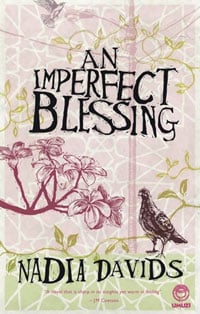
 Title: An Imperfect Blessing
Author: Nadia Davids
Publisher: Umuzi RHS
ISBN: 9781415207154
Buy An Imperfect Blessing from kalahari.com
My first impression of Nadia Davids and her vivacious power with words – as award-winning writer operating as playwright and writer of articles, short stories and screenplays – came about while I was attending the conference The Cape and the Cosmopolitan: reading Zoë Wicomb, hosted by the English department of the University of Stellenbosch in April 2010. On a writers’ panel along with Rustum Kozain, whose reflections on the notion and meaning of “colouredness” carried tremendous heft on the day (and beyond), Davids offered an arresting blend of effusive charm and commitment to academic and social interrogation of the political and personal. That day I knew she would somehow simply have to write a novel, to add to acclaimed theatre productions such as At Her Feet and Cissie. Then 2014 came, the year that Davids exulted readers with her astoundingly resonant debut novel, An Imperfect Blessing, a 400-page exercise in exemplary narrative craft.
Ushered in by Rustum Kozain’s evocative “The Blessing”, a poem that speaks of “children who laugh and play as if untouched by history or by the heavy hands of their parents’ gods”, the novel deliberately spans a period between 1986 and 1993, concluding before the first democratic elections in 1994, but commencing after the initiation of some of apartheid’s grimmest flourishes, including the assassination of ANC stalwart Chris Hani. Such a timeline allows for the sense of movement and flux that went hand in hand with various uncertainties, violations, struggles and triumphs: Davids is concerned with the quotidian and ordinary amid the grand sweep of historical change. She documents with clarity and compassion a deliberate liminality or in-betweenness for her subjects, repeatedly reinforcing the central thesis that no true boundary exists between present and past, that the thinnest of membranes between history and memory, personal and political, is illusory at best. For Davids, to be born in South Africa is no less than a political act.
Davids is unafraid to tackle hefty questions that refuse arbitrary answers: How does transformation and transition take place? Who gets to determine the course and character of relationships? What is the role and impact of history on the common citizen? What are the costs of a radical consciousness and the exigencies of ethical conduct in a time when many different forms of freedom (spatial, intellectual and political) are compromised?
The novel provides a main narrative set in 1993 and a subsidiary narrative set in 1986, to reveal the interpenetrations between past action and present subjectivity. Stated differently, the “past” narrative is used to explore important events that help us to understand characters as they are years later in 1993. Davids is most concerned with various relationships – between individuals, between the individual and historical consciousness (which includes the individual’s awareness that history includes the present, that the past is never dead, not even past), between ideologies, between the state of a country as it experiences rapid change and individuals who are also always open to new and ongoing forms of change and interaction with others.
Davids focalises the novel’s action and themes through the Dawood family, a Muslim collective that has many residing in the windswept Walmer Estate up against Devil’s Peak, and some in Observatory. Alia, 14, desperate to be a part of the change she can sense is taking hold in her country, is the central female character, whose own entry into adolescence and adulthood neatly mirrors South Africa’s transition into democracy. Nasreen is her older, more radical sister; grandmother Fozia is the more traditional figure; their parents the wonderfully three-dimensional pair of Zarina and Adam. While they are concerned with providing the very best education and security for their girls, their own needs and desires often subsumed in the process, we see how they value family ties and closeness, the preservation of their history and heritage, all the while revealing their own quirks, squabbles and prejudices. Here, Davids deserves special commendation for her impeccable characterisation of Adam’s brother Waleed, the law school dropout trudging through research on the ways in which trauma stifles creative output while in a fractious relationship with white academic Anna. Zarina has a particular distaste for the white, Christian woman (who ironically happens to love the treats Waleed brings home for their movie nights after dinner with his family), while Adam’s strained relationship with Waleed harks back to a pivotal sub-plot involving a young activist, Firoze, who is offered temporary aid by the radical, intellectual Waleed. The complexity of the brothers’ relationship as it reveals itself in the “present” moments of 1993 and harks back to the dark days of the “past” in 1986 is captured with heartbreaking empathy and understanding, a commitment to reflecting pain and trauma as unsentimentally and truthfully as possible in the novel form.
Like the great Russian doll narratives by masters such as Tolstoy and Dostoyevsky, ever aware of the multiplicity of relationships that define who we are at any moment, Davids offers ambitious chronicles of these relations between parents, parents and children, brothers, sisters, cousins, and lovers, of various ages and not necessarily of the same racial or cultural affiliation. In its most gentle, wry moments, we see how growing up and maturation as human beings are extremely difficult at the best of times, just as political transformation and transition is incremental, fussy, uneasy, careful and fragile.
As hope and despair rub shoulders, Davids shies away from the abstract in order to emphasise the personal. Whether it be choosing to vote for political parties which at the time included the ANC, Nats, Communist Party, PAC and Azapo, or reflecting on feminism, patriarchy, radical forms of protest or passive forms of individualised resistance, the writer lets her characters live their choices, bearing direct and indirect consequences and almost always also having an influence on the lives of others, deeply intertwined.
Davids’ theatre background goes a very long way in ensuring that her warmly felt, acutely observed characters act and speak like real people, not like a collection of ventriloquised voices that each airs a pre-ordained or simplified number of intellectual arguments or facile “political” platitudes. Individual actions and mannerisms (here I was struck by the downright hilarious mimicry by the tailor Adam of various forms of patois by his Jewish, coloured and Cape Malay patrons, among others) are constructed in an organic way through credible and authentic interactions, allowing the writer to fashion forms of difference, similarity, solidarity and play, while individual characters come across as varied, full-voiced and recognisable.
Rarely has a post-apartheid novel elucidated with such consummate skill how code-switching and dialogue between vastly different people can yield a variety of understandings. Equally, in a novel filled to the brim with remarkable passages – that vary from interrogations of womanhood and what it means to be cool, to the way that social networks are organised in the Cape, political agency, isolation, camaraderie and Cape Malay cooking, wedding rituals and the special prestige and symbolic capital of the Mercedes Benz to Muslim men, to the Cape as destination for so many shackled slaves ferried by boat, the rationale behind the naming of the “Cape Doctor” wind and the elusive meaning of what it means to be “lailai” – never is there a lack of side-splitting, effervescent humour, delicate ruminations on the beautiful and poetic within the tragic and morbid, and a recognition of humanity and grace when all seems to be lost.
There is a true sense of occasion with the release of this novel. Twenty years into democracy, and not even a year after the passing of former president Nelson Mandela, the injunction for us to keep reflecting, to keep making sense – never fully, always imperfectly – is nothing if not a blessing. Incredibly well edited, marrying simplicity with complexity, form and content matched in deft and delicate ways, Davids’s novel never preaches or sermonises; her words are never contrived or manipulative. This is art without tell-tale signs of artifice. With thinking and feeling in near perfect harmony, concluding with an accumulated wisdom and lyrical moment of shared intimacy, An Imperfect Blessing is an essential read.