

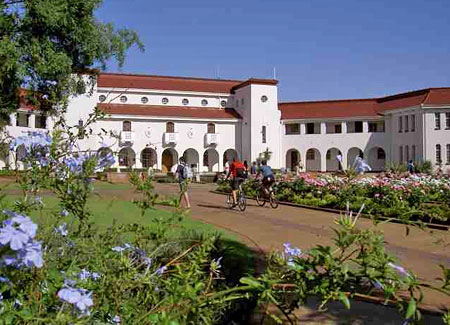
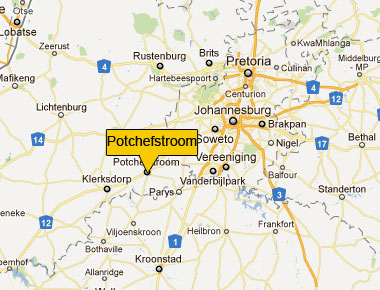
 Next time you’re driving into Potchefstroom, you may hear a plop sound. Don’t worry, none of your tyres has burst. You’re just entering the Puk (Potchefstroom University) bubble. You’re perfectly safe from the outside world. In fact, there is no need to stress too much about anything that extends further than the Mooi River from now on.
I spent four wonderful years at South Africa’s last overwhelmingly Afrikaans university. Despite having a strong Afrikaans heritage, I grew up in an English household and attended English schools. The Puk is steeped in Afrikaans cultural identity and I value the time I spent there. It taught me lessons about a demographic that I would otherwise not have immersed myself in.
It is because of this that I worry about the Puk. In Jonathan Jansen’s book Knowledge in the Blood he says that Afrikaans heritage and values are passed on from one generation to another inside largely enclosed and overwhelmingly Afrikaans schools and institutions.
There is nothing wrong with this, except when it is to the exclusion of other world views. It becomes even more dangerous when it includes negative prejudice, which our fathers fought over and our children will continue to suffer from.
Residence structures place a lot of emphasis on community values. However, it is not okay when my female friends are glared at for walking around Potchefstroom campus hand in hand with a man who happens to be of a different race.
Nor is it acceptable for the presenter of the annual sêr-competition to address a tightly packed auditorium with: “Kom ons begin die aand op die regte manier. Dankie Liewe Jesus dat …”
You can’t blame him, though. Chances are good that many of his lecturers start the first class of the day with a reading from the Bible and prayers. Residences also begin meetings with prayer, despite not everyone on campus being Christian.
I have attended three of the yearly official welcoming ceremonies for first-year students. Without fail, a local Christian religious leader was asked to start of the presentation to thousands of parents and students with a Bible reading and prayer.
The Puk is not a private Christian university. As a public university it must teach its students respect for everyone in South Africa. This cannot be done when the views of a few are so blatantly shoved in the face of others.
 The Puk’s leaders, from students to management, are overwhelmingly concerned with maintaining the university’s beautiful traditions and values. Yet when these exclude respect for those that fall outside the tradition, are they not failing the future of Afrikaners?
They are pulling in the wagons, holding on to the traditions of old, without realising that some of them need to be forcefully ejected, while others must be adapted, if this magnificent language and culture is to grow.
If a university is supposed to promote the acquisition of knowledge then it cannot be right that for years you could buy a beer with your student card, yet not a single newspaper was sold anywhere inside the campus bubble. Apparently nowadays Beeld and Huisgenoot make an occasional appearance.
Since universities should prepare the future generation for an active citizenry role in society, the Puk’s SRC must stop striving to achieve the exact opposite.
The SRC’s draconian constitution prohibits candidates from being elected until they have been approved by the old SRC. Perhaps the Puk is the only place outside of North Korea where candidates cannot market themselves over Facebook and Twitter.
In the recent SRC elections the campus newspaper was refused access to proper election results. Although they could publish which candidates won, the exact percentage that each candidate won or lost by remains a mystery to the newspaper and many students.
Considering that such a system is clearly far from the ideals of democracy, it is hardly surprising that participation in SRC elections is so low.
I remember Pieter Mulder and Mosiuoa Lekota addressing the campus before the 2009 elections. Yet there may have been more public evangelistic concerts than visits by important leaders in recent years.
It is just as important that this home of Afrikaner future is exposed to Barrack Obama, Mamphela Ramphele, Thabo Mbeki and Kgalema Motlanthe, who visit other universities.
This is not just a rant from an ex-student who is too liberal for the bubble. These problems are significant because the real world outside of Potchefstroom matters.
Perhaps 30 years ago it was possible to slide from an Afrikaans high school to the homely, safe Puk and on to a career in a Christian, Afrikaans-speaking environment. But times have changed. Anyone who works in a corporate set-up will tell you that the working world is a diverse place that harbours a huge variety of people, with a kaleidoscope of world views.
Parents who think that they are doing their children a favour by sending them to the Puk because it is safe, comfortable and culturally homogeneous should consider that often challenging and uncomfortable set-ups are exactly what’s needed for growth.
The Puk is a wonderful place, but it’s time for the 21st century to burst the bubble so that everyone who is inside can have more space to grow.
This contribution was produced as part of a collaboration between LitNet and the University of Stellenbosch's Department of Journalism in 2013.
Kommentaar
You make a good point, but I don't fully agree. I am also a student on the Puk and a fouth year. If you go look at the University's "page: then it will state that it is an Afrikaans University, and also a Christian University. The Puk does accommodate English students by supplying interpreting services. According to the law you are allowed to practice your religion, as long as you don't discriminate. I am sorry, but I am very glad to be in an Afrikaans University so if you want an English University - there are so many to pick from. Yes, some of the students lives in a bubble, but don't you think they are allowed to live +- 3-6 years in a bubble considering that they are going to live for the rest of their lives outside the bubble? I am far from a racist and I come from a school that literally accommodate ALL the religions, but I am proud to be a Puk student and think the University are doing just fine. I visited other Universities and to tell you the truth - These issues would be the least of your problems at those universities.
Incompletely agree with the fact that PUK campus is still some sort of enclave for the last few threads of conservative Afrikaans christian mentality. I was brought up in a conservative christian environment and while I myself do not hold faith, I believe just as disrespectful as it is for them to shove their beliefs down our throats, forcing them to abandon it is just as wrong. The best thing to do is to ignore it if it doesn't cause any harm, since flying off the handle just because someone is different is exactly what you preached against. So some interracial couples get strange looks and some classes start with a morning prayer, don't really see the need to get offended. Do what I do, take the five minutes they use to pray to have a nap, and instead of complaining lead by example. And I love how the campus avoids politics and keeps everything running efficiently. Politics and democracy is perfectly fine way to delude the masses into thinking that a mark on a piece of paper matters, but to try and mix politics with academics, not so smart, ask the UOFS.
@ Tanya: "If you go look at the University's "page: then it will state that it is an Afrikaans University, and also a Christian University." Ummm, no, maybe if you can post a link where it says that I'll believe you. PUK hasn't been a exclusively christian university since 1998. It is a university that caters for Afrikaans, since languages and not religious exclusivity is protected by the constitution. What you are stating would have been unconstitutional.
Here is that link that you are looking for that states that religion still plays a role at the NWU: (http://www.nwu.ac.za/content/religion-plays-role-nwu)
Leigh, jy't op die Puk geswot, ek is seker jy verstaan Afrikaans. Verduidelik vir my iets wat ek nog nooit goed begryp het nie. Daar is iets in die wêreld soos vrye assosiasie. Ek is in my 50's en ek leef daarby. As jy op 'n plek kom en iets geval jou nie daar nie, loop. Wat is dit met mense wat altyd alles wil "hervorm"? Jy is een mens wat nie gelukkig was met die gebid op die kampus nie, duisende ander is/was. Nou moet almal verander, want dit pas jou nie. Regtig????