

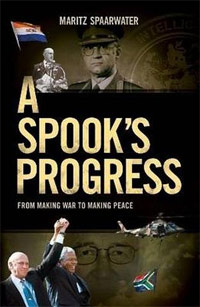
 A Spook’s Progress: From Making War to Making Peace
Maritz Spaarwater
Publisher: Zebra
ISBN: 9781770224377
Buy A Spook’s Progress from Kalahari.com!
First-hand accounts of experiences gained during the so called Border War of the 1970s and 1980s have become a genre all on its own, with new titles appearing almost every month.
The recent release of four titles confirms the public’s curiosity in Southern Africa’s turbulent, not-too-distant past. This time the war in northern Namibia and southern Angola are sidestepped in favour of facets of the violence Sub-Saharan Africa during the Cold War years that are not often touched on in local literature.
Dingo Firestorm: The Greatest Battle of the Rhodesian Bush War, written by Ian Pringle and published by Zebra Press, is recommended. Jacinto Veloso’s Memories at Low Altitude: The Autobiography of a Mozambican Security Chief, also by Zebra, should also be mentioned: autobiographical accounts of the war between Renamo (backed by South Africa’s apartheid regime) and communist-backed Frelimo are scarce.
Closer to home, Endgame: Secret Talks and the End of Apartheid by Willie Esterhuyse (Tafelberg) and A Spook’s Progress: From Making War to Making Peace by Maritz Spaarwater (Zebra) tell of covert meetings and doings that made possible the end of the Border War and apartheid. In Endgame, Willie Esterhuyse – an Afrikaner academic from Stellenbosch – tells how, in May 1989, he was contacted by the Intelligence Service and asked to travel to London and meet with Thabo Mbeki who, like most of the ANC’s top leadership at the time, was in exile.
I randomly chose A Spook’s Progress for proper evaluation. The text on the back promises a recount of “the experiences of an intelligence agent at a key time in South Africa’s history”. Maritz Spaarwater was a senior member of various intelligence agencies during apartheid and among the first to start official discussions with the exiled leadership of the ANC.
Endgame probably spurred on a lot of readers with a fondness for books on South African politics and recent history to buy and read A Spook’s Progress as well. If the Intelligence Service asked Esterhuyse to reach out to Thabo Mbeki and the then banned leadership of the ANC, acquainting oneself with the point of view of a prominent member of that very service can be irresistible.
However, these two books have less in common than might first appear, and reading them in tandem doesn’t really make sense. Endgame is focused, never straying far from “secret talks and the end of apartheid”. A Spook’s Progress is a memoire, recounting the author’s life from his childhood years on, with special emphasis on his career. Being released almost simultaneously with Endgame is a somewhat unfortunate coincidence that may or may not stimulate sales of Spaarwater’s book.
The first few chapters of Spaarwater’s book have him reminiscing on his earliest years, which makes for interesting reading. After finishing school, Spaarwater volunteered for a year’s military training, after which he studied law. While working as an articled clerk he was persuaded by an officer of the security branch of the South African Police to provide information on defence-related contracts handled by one of the partners of the firm that Spaarwater worked for. This sparked Spaarwater’s interest in the world of intelligence.
Not long after this he applied for a position in military intelligence. Later on he transferred to the National Intelligence Service. Spaarwater sporadically interrupts his narrative to enlighten readers on his thoughts on several political matters, including the workings of the Afrikaner Broederbond.
Spaarwater “entertains” readers from time to time with anecdotes of the meetings he and some of his colleagues had with, among others, Kenneth Kaunda and Sam Nujoma, but this amounts to little more than name-dropping.
The second half of the book deals almost exclusively with events leading up to the dismantling of apartheid and, as it turns out, the author’s rather modest role in the peace process. But the author chose to be stingy with what he would reveal and not to step on too many toes or turn his book into something more sensational and exiting. The result is 282 pages of what can only be described as optional reading.
Teken in op LitNet se gratis weeklikse nuusbrief. | Sign up for LitNet's free weekly newsletter
Kommentaar
Ek weet 'n skrywer behoort nie op kritiek op sy werk te reageer nie, maar ek is ietwat verstom dat JB Roux die hooftema van my boek, A Spook's Progress, so totaal kon mislees. Ek vermoed dat hy met vooropgesette idees 'n "spy thriller" á la John le Carré verwag het en toe nie by sy selfgeskepte oogklappe verby kon lees nie. Die tema in memoire-vorm is die kopskuiwe by 'n indiwidu in tandem met dié binne die Afrikaner-magstruktuur wat tot die aftakeling van apartheid gelei het. Selfs die betekenis van mense soos Kaunda, Nujoma en Kito Rodrigues van Angola se pleidooie om vrede, gaan by hom verby en word bloot "name-dropping". Gelukkig is daar ook gerekende historici, akademici en ander resensente wat die punt van die boek duidelik begryp het. 'n Baie swak resensie, natuurlik teleustellend vir enige ernstige skrywer. Ek weet nie wie JB Roux is nie en kan dus nie oordeel wat hom hom laat aanmatig om boeke te resenseer nie. Ek stel voor hy los dit liewer.