

This reader’s impression was written and sent to LitNet on the writer’s own initiative.
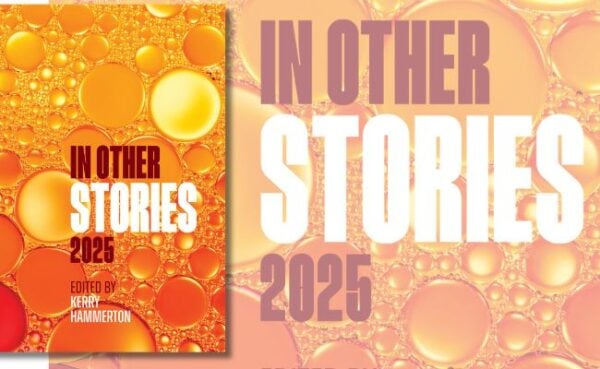
In other stories 2025
Edited by Kerry Hammerton
Published by Karavan Press
ISBN: 9781067222468
In her introduction to this anthology, Kerry Hammerton begins by defining flash fiction such as this in terms of a strict word limit. This makes perfect sense: Each story included here shares the economy of expression we have come to expect from the genre.
Hammerton goes on, however, to add an additional, less obvious definition: “A flash is not simply a story that has been pared back to its bare bones. Instead, it concentrates on movement; every word and sentence is important to the progression of the story …. The flash asks the reader to make intuitive leaps for understanding.”
This is a useful clue for reading the stories selected for this anthology. While several fine stories here tie up their loose ends in very few words, the best of them almost invariably unsettle the reader’s expectations in one of two ways.
Some stories brilliantly suggest power dynamics that have been building off the page for a long time, and pointedly resist tidy resolutions of any kind. Karina M Szczurek’s “Toxic choreography” is an excellent example of this kind of narrative, and so are Rachel May Ferriman’s “Wishlist” and Hammerton’s own “Silver birch”. These works of fiction gather our attention at a particular point of crisis, forcing us to ask what we ourselves would do in the narrator’s situation.
Other stories build more slowly, but gradually draw us into turbulent landscapes through the careful accumulation of finely observed details. Sarah Buchner’s “Donald Bradman and the superfluid”, Melissa Sussens’s “No body” and Tiisetso Tlelima’s hilarious “My funeral” are some of the best examples of this kind of story. Whether they rush us to a raucous ending like Tlelima’s, or thrive on uncertainty and speculation like Sussens’s, they are small masterpieces of timing.
There are stories here that ask profound, unsettling questions about what it means to be in relationship, or to be human at all. Mike Boyd’s “Swallow” and Limor Kay’s “Good times” both evoke the powerful hold of memory on our present actions, while Stephen Symons traces the whereabouts of an SS badge across time until its original meaning becomes lost to those who stumble on it by chance.
Some stories, like Nontobeko Mtshali’s “A homecoming”, engage with traditional beliefs that both interrupt and inform their narrators’ lives, while other voices represented here are activistic without ever becoming simply didactic. Bongani Kona’s “This report contains details that may be unsettling to some viewers”, for instance, offers a sharp, visceral response to xenophobia, while Siphosethu Siwaphiwe Zazele’s “Nokuzola” conjures the struggle of a powerful woman against the patriarchy that is trying to limit her access to land and resources.
Finally, there are stories here that either take us into the realm of magical realism (Michelle A Meyer’s “I’ll wait, little girl-bird, I’ll wait” and Petros Isaakidis’s extraordinary “Heatwave”, which closes the collection) or blur the distinction between fact and fiction. Among the latter, Karen Jennings’s “Jan Smiesing: Teacher and slave” stands out as a moving, understated portrait that forces us to reimagine an entire epoch, while Chantal Stewart’s “Night train from Lourenço Marques to Johannesburg” draws on family memory to tell a story that is as haunting as it is honest.
While readers’ tastes will, of course, differ, there is something rewarding in each of these stories. Whether their aim is to entertain or to unsettle, they all extend the range of what is possible for us to experience and imagine. One hopes that the partnership between Hammerton and Karavan Press will produce more such anthologies in the future.