

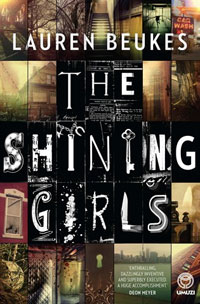
 Title: The Shining Girls
Author: Lauren Beukes
Publisher: Umuzi
ISBN: 1415202012
Buy The Shining Girls from Kalahari.com.
It doesn’t come any grimmer, grittier or more imaginative than this.
For those as yet unfamiliar with the audacious premise of award-winning novelist Lauren Beukes’s latest literary endeavour, here it is.
In 1931, at the height of the Great Depression, psychopathic hobo Harper Curtis discovers a wormhole in time in a residential home (ostensibly derelict) in Chicago’s rundown Englewood district. Here this depraved misanthrope, with his penchant for ultra-violence (and predilection for inflicting it through vicious, gory disembowelments and throat-slitting) not only finds safe harbour; he is also confronted by his murderous destiny: a room with a list of women’s names rewritten many times in his own hand and a collection of ghoulish trinkets plucked from his hapless, preordained female victims – the “shining girls” of the novel’s title.
Having made his fantastical discovery, Harper erratically and unpredictably slides in and out of time on the hunt. Over the course of 60 years (between 1931 and 1993) he “enters” various eras at will and in a non-chronological order stalks, tortures and murders individualistic, independent-minded women whose talent and drive simultaneously attract and madden him. Unbeknown to our villain, however, in 1989 one young woman survives his brutal onslaught. In the ensuing years our frail yet indomitable heroine, Kirby Mazrachi, becomes obsessed with tracking down her would-be killer, until finally they confront each other in a satisfyingly climactic finale.
A shout-out on Beukes’s second novel, Zoo City, recipient of the 2011 Arthur C Clarke Award (for science fiction writing) – and the book that started all the hype currently making Beukes such a media darling and literary rock star – describes the author as “Jeff Noon crossed with Raymond Chandler”. While its time travel premise (among other aspects) clearly sets The Shining Girls apart from your average noir thriller, as far as tone and setting are concerned this violent tale is very much grounded in reality. The author’s more hardbitten sci-fi fanboys and gals should thus ready themselves for more Philip Marlowe and less Philip K Dick.
Gritty, believable evocations of Chicago throughout various watershed historical eras and Beukes’s interesting, vital female casualties (an African American widow turned welder, a brassy architect who fears being branded a “Red”, an abortionist, a coy transsexual, among others) also lend the novel a firm social conscience.
Beukes’s painstaking historical research delivers up authentic, yet slightly clichéd renderings of the eras she chooses to highlight – from the grunge-era 1990s, to the paranoid spectre of McCarthyism in the mid-1950s, to the politically disenchanted Nixon-era ‘70s, and so on.
Her strong, vibrant writing displays her canny sense of place (she did the same with Cape Town in Moxyland and with Jozi in Zoo City). This is one of this novel’s strengths. Her text is also (impressively) free of glaring anachronisms and richly peppered with dialogue capturing the native parlance of each age the author has chosen to focus on.
But there is something frustrating about the either derivative or “Hollywood stock character” nature of Beukes’s leads: plucky, prickly, and punkish Kirby, for example, reads like a more mouthy, less hardcore American incarnation of Stieg Larsson’s Lisbeth Salander. And like Larsson’s dragon-tattooed anti-heroine, the doggedly determined Kirby also has a jaded journo cum not-quite-father-figure sidekick in the form of disenchanted crime writer turned sports hack Dan Velasquez. How many times has an unglamorous (but potentially attractive), badly dressed, ethically minded, divorced middle-aged pressman or beat cop not featured in a crime novel or suspense flick? Similarly, Beukes’s portrayal of Kirby’s difficult relationship with her free-spirited, pot-smoking, boho-chic baby boomer mother, Rachel, has a hackneyed feel. It’s as if Beukes lived herself wholeheartedly into various clichés of Americana and then created a sophisticated literary amalgam of them. There is no denying how stylishly she achieves this, but it somehow still feels trite in a way that, say, David Mitchell’s inhabiting of genres in Cloud Atlas does not.
There’s something very film-like about how this novel reads and plays out – it’s one of those cases where one feels the author is rehearsing for a screenplay – rather like a Stephen King book, but with much better prose. As I read, I kept casting and recasting the leads in an imagined Hollywood blockbuster version in my head: “Perhaps Jennifer Lawrence as Kirby and Benicio Del Toro or Andy Garcia as Dan? And definitely Ryan Gosling – especially after his murderous turns in Drive and All Good Things – as Harper?” (The idea of LA bigwigs knocking on Beukes’s door is also not that far-fetched, considering that she is herself in the middle of writing a screen adaptation of Zoo City.)
Does Beukes manage to highlight the gruesome brutality of femicides (of the kind most recently perpetrated against Anene Booysen) in a manner that gut-punches the reader and brings home the unsexy, horrific truth of such brutal slayings?
Yes.
Does she humanise her novel’s female victims in a way that more generic serial killer noir narratives seldom manage?
Yes, to a greater or lesser degree, depending on the character.
Is her serial killer convincing and appropriately creepy?
Hell, yes. And then some. Harper is a time-hopping Ted Bundy par excellence.
Does she maintain her pace and keep a hold of her plot in a way that will prevent sci-fi nerds fulminating like Doc Brown in Back to the Future about gaps in the space/time continuum?
For the most part. Like Ariadne with her ball of string which helped guide Theseus safely through the Minotaur’s maze, Beukes has a confident hold on the disparate cords that lead us through her involved literary labyrinth. There are some inevitable unanswered questions and implausible elements here and there, but nothing that overly rankles.
Should you read The Shining Girls?
If you enjoy hair-raising crime fiction and can handle the time travel twist and overwhelming body count, by all mean yes. The Shining Girls is an adeptly crafted spine-tingler.
Teken in op LitNet se gratis weeklikse nuusbrief. | Sign up for LitNet's free weekly newsletter.