

Met respek:
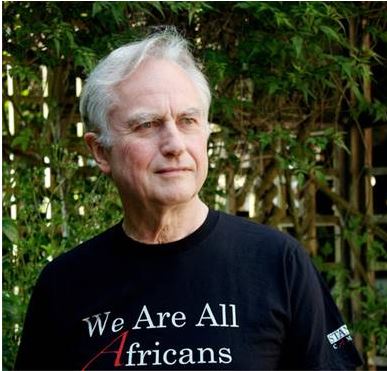
Black, 100% cotton, pre-washed t-shirt.
Made in USA.
"We Are All Africans"
on the front,
Our Campaign logo on the sleeve,
and
"The Bible says modern people are the result of incestuous relations Cain and his brothers had with their sisters. Science says we are all descendants of Africans. I believe science"
on the back.
Vir geruime tyd reeds vul Richard Dawkins sy beursie met sulke swak redenasies wat hy selfs op T-hemde laat druk. Naïwelinge eet sy "vasomlynde leerstukke" soos soetkoek, met dieselfde soort napraat waarmee Bybelaanbidders alles tot hul drogma konformeer.
Hierdie foefie van Richard Dawkins, gebruik dan ook dieselfde Bybelaanbidders as sy strooipoppe; nes almal al so gewoond geraak het aan die ateïste se "duiwe met ketties skiet" op die werf.
Die twiet wat my hier gebring het, lees as volg:
@RichardDawkins Not only are "We All Africans" , our species is genetically exceptionally uniform. Evolution makes nonsense of racism. 8:32 PM - 22 Aug 13
Richard Dawkins, stel duidelik "spesies" met "ras" gelyk.
Nie dat dit ooit 'n probleem vir Richard Dawkins se napraters sou wees nie; (sonder enige ophef daaromtrent bedoeld) die werf se infernale "Spiritueel Intelligente" hoëpriester van die Bybelaanbidders, Kobus de Klerk, stel eweneens woorde in hul besondere verklaring gelyk aan mekaar waar dit hom pas (byvoorbeeld ateïs en agnost), en eweneens sal sy sikofante en paranimfe in gees vervulde trane uitbars oor die twak daarin!
Honde, val byvoorbeeld onder die karnivore as 'n subspesie (veronderstel te wees - maar meeste is nes hul base gestroop van hul identiteit - eet selfs mieliepap).
Die Wiki se inleiding oor honde:
The domestic dog (Canis lupus familiaris) is a subspecies of the gray wolf (Canis lupus), a member of the Canidae family of the mammalian order Carnivora. The term "domestic dog" is generally used for both domesticated and feral varieties. The dog was the first domesticated animal and has been the most widely kept working, hunting, and pet animal in human history. The word "dog" can also refer to the male of a canine species, as opposed to the word "bitch" which refers to the female of the species. MtDNA evidence shows an evolutionary split between the modern dog's lineage and the modern wolf's lineage around 100,000 years ago but, as of 2013[update], the oldest fossil specimens genetically linked to the modern dog's lineage date to approximately 33,000–36,000 years ago.
Die Wiki se inleiding oor homo sapiens (dis ons):
Homo sapiens (Latin: "wise man") is the scientific name for the human species. Homo is the human genus, which also includes Neanderthals and many other extinct species of homonid; H. sapiens is the only surviving species of the genus Homo. Modern humans are the subspecies Homo sapiens sapiens, differentiated from their direct ancestor, Homo sapiens idaltu.
Ten einde verklaar:
"Breed is usually applied to domestic animals; species or variety to wild animals and to plants; and race to men." Webster's Revised Unabridged Dictionary
Na jare se teling met hulle, het die uwe vandag steeds 'n passie vir Chow-Chows.
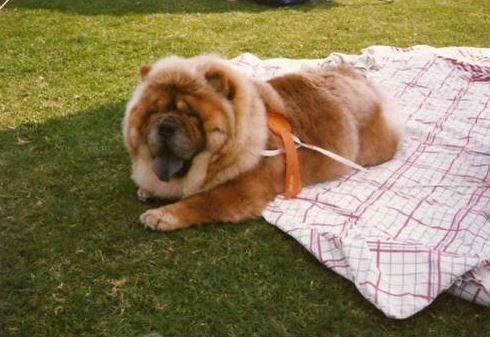
Hierdie was (en steeds met verlange) die punt van my hart - Kampioen - Chinabear Royal Star (Ben)
Uit die Wiki se opstel oor Chow Chows:
Recent DNA analyses confirm that this breed is one of the oldest dog breeds. Research indicates it is one of the first primitive breeds to evolve from the gray wolf, and is thought by many to have originated in the arid steppes of northern China/Mongolia, although other theorists conjecture that its origin is in Siberian regions of Asia
Ook het mense rasse, op byna dieselfde gronde nes die van honde se "breeds" ontstaan.
Uit die Wiki se opstel oor die "menslike genetiese variasie":
Our history as a species also has left genetic signals in regional populations. For example, in addition to having higher levels of genetic diversity, populations in Africa tend to have lower amounts of linkage disequilibrium than do populations outside Africa, partly because of the larger size of human populations in Africa over the course of human history and partly because the number of modern humans who left Africa to colonize the rest of the world appears to have been relatively low (Gabriel et al. 2002).
Uit die Wiki se opstel oor die mees antieke inwoners van Afrika:
In the 1990s, genomic studies of world peoples found that the Y chromosome of San men (using samples drawn from several tribes) share certain patterns of polymorphisms that are distinct from those of all other populations. Because the Y chromosome is highly conserved between generations, this type of DNA test is used to determine when different subgroups separated from one another, and hence their last common ancestry. The authors of these studies suggested that the San may have been one of the first populations to differentiate from the most recent common paternal ancestor of all extant humans, the so-called Y-chromosomal Adam by patrilineal descent, estimated to have lived 60,000 to 90,000 years ago. The authors also note that their results should be interpreted as only finding that the Khoisan "preserve ancient lineages", and not that they "stopped evolving" or are an "ancient group", since subsequent changes in their population are in parallel and similar to those of all other human populations.
Die punt is; in elke spesie op aarde word daar oral "breeds/ras", in die biologie omskryf.
"Ras/breed", onderskei die fynere biologiese verskil tussen 'n Chow Chow en 'n Maltees; nes daar met respek 'n onderskeid aan "ras" (DNA) tussen die Khoisan en die Sami, op dieselfde logiese gronde gemaak word.
Derhalwe, gereken dat die sjimpansee se DNA, ook net 'n enkele persentasie punt van die mens verskil - tog word hulle deeglik as spesie van die mens onderskei - daar sekerlik ook aan die hand van Richard Dawkins se slimmigheid gereken kan word; dat die primate in geheel, as 'n spesie in besonder - "genetically exceptionally uniform" - is.
Ek is oortuig dat Richard Dawkins intelligent genoeg is om al hierdie te weet, maar nes hy lekker geld uit die ergerlike onthutstheid van ontnugterde Protestante maak - net so is hy besig om in die korpokrasie se liberale agenda te kruip - om daarmee nie net harte se eenselwigheid in ons Skepper verdag te probeer maak nie - maar ook die mens se identiteit aan "ras", onder verdenking te probeer plaas.
Die woord "ras" mog wel glans verloor het jeens al die gruwelike vergryp deur bose onderdrukkers daaraan. Dit sal egter weldra met 'n ander, meer sosiale aanvaarbare woord soos byvoorbeeld "menslike-genetiese-variasie" vervang word, maar die werklikheid rakende die biologiese omskrywing van "breeds/ras", sal gewis nooit deur allerlei valse liefde en ydele verdagmakery, soos dié van 'n Richard Dawkins, onder 'n vaandel van "demokrasie" en "liberalisme", verander kan word nie!
Ek deel hierdie besonderse video deur 'n Afrikaan in diaspora - Cassius Clay (alias Mohammed Ali), in antwoord op 'n tipiese "geldmaak Richard Dawkins", wat so op onder meer Afrika se hartseer en sentimente probeer kapitaliseer:
Opregte groete,
Hindoe-, Moslem-, Joodse, Boeddhistiese, katolieke en Afrikaliefde,
Cornelius Henn
Kommentaar
Beste Cornelius,
Beste Cornelius,
Beste Angus,
Met respek; as jy iets vlugtig lees en jou kommentaar lewer asof jy 'n punt het, gaan ek regtig nie my tyd mors om jou wanopvattinge verder te neem nie ... indien jy tyd vind, lees asseblief my bydrae sorgvuldig en hersien jou kommentaar op behoorlike aanhalings gegrond - of los dit ... ek het geen bedoeling om fundamentele ateïste ten opsigte van fundamentele Bybelaanbidders uit te sonder nie - die een is so erg soos die ander - Richard Dawkins en sy dissipels is nes 'n Kobus de Klerk met sy aanhangers ... ek vind dit steeds ongelooflik hoe jy verskille in DNA, in watter opsig ookal, buite biologie beskou - en dan; ras is ALTYD kunsmatig, ook aan mense; hetsy dit 'n boer met plan met sy skape is, of dit 'n hiërargie is wat onderdane manipuleer ... OF, dit gewoon uit selfrespek is wat 'n bokser soos Mohammed Ali, die een en ander hier kan leer ...
Opregte groete,
Cornelius Henn
... en o ja, ek gee nie voor dat dit Dawkins is wat 'n onderhoud met Mohammed Ali voer nie - lees weer - ek het getik: in antwoord op 'n tipiese "geldmaak Richard Dawkins" - let asseblief op die leestekens en woorde daarin soos "'n tipiese" - dink dan aan; 'n eienaardigheid wat kenmerkend is; kenmerkende beskrywing; soos in 'n vergelyking... kensketsend, tekenend ... ensovoorts ... daar is hoegenaamd geen sin om rede te voer as taal nie ooreenstem nie ...
... en wyl selfverhewe slimjannies gedurig die Internet verdag maak (wyl hulle dit met oorgawe vir hul eie propaganda gebruik) - in hierdie geval dat daar kamstig geen definisie vir ras in die biologie bestaan nie - of te wel, ras, glo nie biologies definieerbaar is nie - kliek gerus op hierdie skakel en besluit self of dit regtig nodig is om in een of ander eksklusiewe biblioteek oor die onderwerp navorsing te moet gaan doen: http://www.google.com/search?q=biology+definition+breed+race&rls=com.microsoft:af-ZA:IE-Address&ie=UTF-8&oe=UTF-8&sourceid=ie7&rlz=1I7GGNI_en-GBZA534
https://www.google.co.za/#fp=b9e55bd8b1c2efe7&q=help+for+delusional+people
Bemoedigend om te sien dat Chris Dippenaar minstens sy stryd op die Internet kan nalees ... my waarneming omtrent Richard Dawkins en Chris Dippenaar, is dat hulle almal hulself in hul staat van begoël te wees, obsessief met die seuntjie in die kaal keiser fabel identifiseer ... onskuldig, eerlik, dapper, die wêreld skud met hul waarneming dat die Bybel, nie die Woord van God is nie ... ja, min wetende dat daar miljoene katolieke is wat ook nie die Bybel verafgod nie ...
Hello,
Hoe slim is die arme "nerd" Wouter Ferns (soos hy graag vir soeke na simpatie en na homself verwys)?
Of, hoe moedswillig is die werf se patetieke slimjannie?
Hoe objektief kan 'n uitgesproke anderhater soos Wouter Ferns, oor my bydraes wees?
Ja, vir die kruipers en ander aktiviste wat ander se harte gedurig hier minag en Godsdiens probeer ondermyn, is die patetieke bleeksiel Wouter Ferns gewis 'n steunpilaar met sy disinformasie.
Om slegs 'n enkele aspek uit vele te noem; ek het reeds menigmaal die betekenis aan die woord katoliek, met 'n klein letter gespel, hier verduidelik. Vir enigeen wat steeds daaroor wonder: https://www.litnet.co.za/Article/oor-n-enige-katolieke-kerk
Die punt hier ter sprake, is Richard Dawkins se gelykstel van "spesie" met "ras".
En soos altyd maar, kon Wouter Ferns weereens nie by die punt hou nie.
Richard Dawkins onderskei nie "ras" biologies as dit by mense kom nie, maar doen dit wel by diere.
Hoekom?
Glo hierdie godslasteraars dalk dat die mens, die kroon van die Skepping is en daarom verhewe bo die "bio" op die res van die aarde is?
Of weier hierdie godslasteraars om die Bybel se lering dat ons uit die stof (elemente) van die aarde geformeer is, te erken - net omdat dit ook in die Bybel staan?
Ja, die Bybel leer wel dat ons "bio", vlees en bloed, nes die van die res van die "bio" op aarde, weer tot die elemente (stof) van die aarde, sal terugkeer.
Aan die hand van hierdie gelyke "bio" van die mens in die res van die Skepping, kan "ras" by mense - dus nes by diere - maklik biologies gedefinieer word.
In hierdie lewe funksioneer en bestaan my vlees en bloed, ook nes die vlees en bloed van enige ander skepsel op aarde - eet, drink, slaap, wek 'n nageslag, sorg vir my nageslag, soek my soort op, identifiseer met my DNA ...
Ons HART, behoort aan God - al is dit aan ons vlees en bloed gebonde in hierdie lewe.
Cornelius Henn
... en o ja, ek wonder of Richard Dawkins se begogelde op die werf soos Chris Dippenaar en Wouter Ferns, dalk reken dat hul getal en kruipery onder mekaar, sonder om hoegenaamd my vrae te kan beantwoord, die argument kan "wen"?
Nog advies:
Beste Angus, dankie vir jou advies; asook die bedekte kompliment daarin - ja, wie't ooit gedink ek kan iets buiten dit op die werf publiseer? ... Angus, met die borgskap van iemand in die korpokrasie wie sodanige titel "Ras, 'n biologiese realiteit" as deel van hul agenda nodig, sal ek dit beslis oorweeg en jou ook daarin bedank ... met respek egter aan al die name wat jy noem; ek dink nie enige ander is onnosel nie - net afgerond in 'n bepaalde geldgedrewe bedoeling ... nederige groete, Cornelius Henn
Beste Cornelius,
Hello,
Hello
Wouter Ferns, iets wat jy nes Kobus de Klerk sal moet aanvaar, is die feit dat net omdat jy dit as "uitgevang" beskou, dit nie noodwendig so is nie ... derhalwe, jy karring nou nog dat die sinkretiese uitdra van die Evangelie, my besondere lering is; dat die woord "katoliek" met 'n kleinletter, my versinsel is; dat die Afrikaners in 1913 met die eerste Apartheidswette, aan bewind was ... om slegs enkele punte omtrent jou "nerd" waansin te noem ... ek dink regtig ter wille van soveel ander belangstellendes ook hier, jy jou slimmigheid en eentonige vyandigheid teenoor my standpunte liefs onder beheer moet bring ... glo my, meeste hier kan vir hulself dink en het nie jou onderdrukkende mening oor my nodig nie ... nie te danke, Cornelius Henn
Beste Angus, ek beskou geen mens op aarde as onnosel nie; ook nie een Kobus de Klerk, Jaco Fourie of Wouter Ferns nie ... inteendeel, raak net regtig teleurgesteld met die aanskoue van soveel kognitiewe dissonansie deur soveel intelligente mense andersyds ... Cornelius Henn
Beste Angus, wyl ek jou aandag het; ek sou regtig 'n antwoord waardeer waar iemand met jou besonderse rede, vir my sal verduidelik hoekom "ras" elders, behalwe in die geval van mense, en ook volgens jou biologies definieerbaar is ...
En tot walgings toe Wouter Ferns,
... selfs in die woordeboek bestaan die woord katoliek met 'n kleinletter, en word daarin as volg verklaar:
katoliek3, (b), =e. Algemeen, allesomvattend; oor die hele wêreld versprei.
... en Katoliek met 'n hoofletter daarenteen:
Katoliek1, (s), =e. Iem. wat die Rooms-Katolieke geloof aanhang.
Katoliek2, (b), =e. Die Rooms-Katolieke geloof toegedaan; volgens die Rooms-Katolisisme.
Wouter Ferns, lewer kommentaar oor die onderwerp. Jou beheptheid met my is beslis ongesond en dit lyk nie of jy enige ander algemene kennis buiten jou gebreinspoelde slimmigheid in die massamedia het nie.
Jy is ook lankal reeds 'n pyn met jou "arme nerd" selfbeheptheid, al lyk dit of 'n paar ander hier in hul selfbejammering vir jou bloei!
Nie te danke nie,
Cornelius Henn
Angus
Ek het ook maar die Suid-Afrikaner se eenvoudige tradisionele siening van ras gehuldig as net die fisiese voorkom van die persoon, nl wit of swart. Ek het ongelukking nie die tyd om 'n studie van hierdie heel interessante onderwerp te kan maak nie, te veel ander belangstellings wat my aandag trek.
Ek het derhalwe veel van jou wys geword, wat my siening oor ras laat wysig het. Baie dankie vir jou wetenskaplike, objektiewe en verfrissende inligting
Jaco Fourie
Toemaar Angus, ek berus met die volgende copy&paste van Wouter Ferns, elders onderaan een van jou bydraes rakende die onderwerp:
(begin van aanhaling)
Hello,
Die lesers word van my [Wouter Ferns] kant af gelaat met 'n Op-Ed van Armand Leroi uit die New York Times van 'n wyle terug as 'n manier om Henn te help om volgens 'bio', genetika maw, 'n argument te begin formuleer vir die bestaan van ras en daarmee ook dan die bevryding van Henn van die woordeboek se rokspante.
Net die toepaslike gedeeltes word aangehaal. Richard Lewontin het elders daarop reageer maar sal nie aangehaal word nie:
A Family Tree in Every Gene By ARMAND MARIE LEROI If modern anthropologists mention the concept of race, it is invariably only to warn against and dismiss it.Likewise many geneticists. "Race is social concept, not a scientific one," according to Dr. Craig Venter - and he should know, since he was first to sequence the human genome. The idea that human races are only social constructs has been the consensus for at least 30 years.
But now, perhaps, that is about to change. Beneath the jargon, cautious phrases and academic courtesies, one thing was clear: the consensus about social constructs was unraveling. Some even argued that, looked at the right way, genetic data show that races clearly do exist.
The dominance of the social construct theory can be traced to a 1972 article by Dr. Richard Lewontin, a Harvard geneticist, who wrote that most human genetic variation can be found within any given "race." If one looked at genes rather than faces, he claimed, the difference between an African and a European would be scarcely greater than the difference between any two Europeans.
A few years later he wrote that the continued popularity of race as an idea was an "indication of the power of socioeconomically based ideology over the supposed objectivity of knowledge."
Most scientists are thoughtful, liberal-minded and socially aware people. It was just what they wanted to hear.
Three decades later, it seems that Dr. Lewontin's facts were correct, and have been abundantly confirmed by ever better techniques of detecting genetic variety. His reasoning, however, was wrong. His error was an elementary one, but such was the appeal of his argument that it was only a couple of years ago that a Cambridge University statistician, A. W. F. Edwards, put his finger on it.
The error is easily illustrated. If one were asked to judge the ancestry of 100 New Yorkers, one could look at the color of their skin. That would do much to single out the Europeans, but little to distinguish the Senegalese from the Solomon Islanders. The same is true for any other feature of our bodies.
The shapes of our eyes, noses and skulls; the color of our eyes and our hair; the heaviness, height and hairiness of our bodies are all, individually, poor guides to ancestry. But this is not true when the features are taken together. Certain skin colors tend to go with certain kinds of eyes, noses, skulls and bodies. When we glance at a stranger's face we use those associations to infer what continent, or even what country, he or his ancestors came from - and we usually get it right.
To put it more abstractly, human physical variation is correlated; and correlations contain information. Genetic variants that aren't written on our faces, but that can be detected only in the genome, show similar correlations.
It is these correlations that Dr. Lewontin seems to have ignored. In essence, he looked at one gene at a time and failed to see races.
But if many - a few hundred - variable genes are considered simultaneously, then it is very easy to do so. Indeed, a 2002 study by scientists at the University of Southern California and Stanford showed that if a sample of people from around the world are sorted by computer into five groups on the basis of genetic similarity, the groups that emerge are native to Europe, East Asia, Africa, America and Australasia - more or less the major races of traditional anthropology.
One of the minor pleasures of this discovery is a new kind of genealogy. Today it is easy to find out where your ancestors came from - or even when they came, as with so many of us, from several different places. If you want to know what fraction of your genes are African, European or East Asian, all it takes is a mouth swab, a postage stamp and $400 - though prices will certainly fall.
Yet there is nothing very fundamental about the concept of the major continental races; they're just the easiest way to divide things up.
Study enough genes in enough people and one could sort the world's population into 10, 100, perhaps 1,000 groups, each located somewhere on the map.
This has not yet been done with any precision, but it will be. Soon it may be possible to identify your ancestors not merely as African or European, but Ibo or Yoruba, perhaps even Celt or Castilian, or all of the above. The identification of racial origins is not a search for purity.
The human species is irredeemably promiscuous. We have always seduced or coerced our neighbors even when they have a foreign look about them and we don't understand a word. If Hispanics, for example, are composed of a recent and evolving blend of European, American Indian and African genes, then the Uighurs of Central Asia can be seen as a 3,000-year-old mix of West European and East Asian genes.
Even homogenous groups like native Swedes bear the genetic imprint of successive nameless migrations.
Some critics believe that these ambiguities render the very notion of race worthless.
I disagree.
The physical topography of our world cannot be accurately described in words. So, too, it is with the genetic topography of our species. The billion or so of the world's people of largely European descent have a set of genetic variants in common that are collectively rare in everyone else; they are a race.
At a smaller scale, three million Basques do as well; so they are a race as well.
Race is merely a shorthand that enables us to speak sensibly, though with no great precision, about genetic rather than cultural or political differences.
But it is a shorthand that seems to be needed. One of the more painful spectacles of modern science is that of human geneticists piously disavowing the existence of races even as they investigate the genetic relationships between "ethnic groups." Given the problematic, even vicious, history of the word "race," the use of euphemisms is understandable. But it hardly aids understanding, for the term "ethnic group" conflates all the possible ways in which people differ from each other.
Indeed, the recognition that races are real should have several benefits.
To begin with, it would remove the disjunction in which the government and public alike defiantly embrace categories that many, perhaps most, scholars and scientists say do not exist.
Second, the recognition of race may improve medical care. Different races are prone to different diseases. The risk that an African-American man will be afflicted with hypertensive heart disease or prostate cancer is nearly three times greater than that for a European-American man. On the other hand, the former's risk of multiple sclerosis is only half as great. Such differences could be due to socioeconomic factors. Even so, geneticists have started searching for racial differences in the frequencies of genetic variants that cause diseases.
They seem to be finding them.
Race can also affect treatment. African-Americans respond poorly to some of the main drugs used to treat heart conditions - notably beta blockers and angiotensin-converting enzyme inhibitors. Pharmaceutical corporations are paying attention. Many new drugs now come labeled with warnings that they may not work in some ethnic or racial groups.
Here, as so often, the mere prospect of litigation has concentrated minds.
Such differences are, of course, just differences in average.
Everyone agrees that race is a crude way of predicting who gets some disease or responds to some treatment. Ideally, we would all have our genomes sequenced before swallowing so much as an aspirin.
Yet until that is technically feasible, we can expect racial classifications to play an increasing part in health care.
The argument for the importance of race, however, does not rest purely on utilitarian grounds.
There is also an aesthetic factor. We are a physically variable species. Yet for all the triumphs of modern genetics, we know next to nothing about what makes us so. We do not know why some people have prominent rather than flat noses, round rather than pointed skulls, wide rather than narrow faces, straight rather than curly hair. We do not know what makes blue eyes blue.
One way to find out would be to study people of mixed race ancestry. In part, this is because racial differences in looks are the most striking that we see. But there is also a more subtle technical reason.
When geneticists map genes, they rely on the fact that they can follow our ancestors' chromosomes as they get passed from one generation to the next, dividing and mixing in unpredictable combinations.
That, it turns out, is much easier to do in people whose ancestors came from very different places.
The technique is called admixture mapping. Developed to find the genes responsible for racial differences in inherited disease, it is only just moving from theory to application.
But through it, we may be able to write the genetic recipe for the fair hair of a Norwegian, the black-verging-on-purple skin of a Solomon Islander, the flat face of an Inuit, and the curved eyelid of a Han Chinese. We shall no longer gawp ignorantly at the gallery; we shall be able to name the painters.
There is a final reason race matters. It gives us reason - if there were not reason enough already - to value and protect some of the world's most obscure and marginalized people.
When the Times of India article referred to the Andaman Islanders as being of ancient Negrito racial stock, the terminology was correct. Negrito is the name given by anthropologists to a people who once lived throughout Southeast Asia.
They are very small, very dark, and have peppercorn hair. They look like African pygmies who have wandered away from Congo's jungles to take up life on a tropical isle.
But they are not.
The latest genetic data suggest that the Negritos are descended from the first modern humans to have invaded Asia, some 100,000 years ago. In time they were overrun or absorbed by waves of Neolithic agriculturalists, and later nearly wiped out by British, Spanish and Indian colonialists.
Now they are confined to the Malay Peninsula, a few islands in the Philippines and the Andamans.
The fate of one tribe, the Sentinelese, remains uncertain, but an Indian coast guard helicopter sent to check up on them came under bow and arrow attack, which is heartening. Even so, Negrito populations, wherever they are, are so small, isolated and impoverished that it seems certain that they will eventually disappear.
Yet even after they have gone, the genetic variants that defined the Negritos will remain, albeit scattered, in the people who inhabit the littoral of the Bay of Bengal and the South China Sea. They will remain visible in the unusually dark skin of some Indonesians, the unusually curly hair of some Sri Lankans, the unusually slight frames of some Filipinos. But the unique combination of genes that makes the Negritos so distinctive, and that took tens of thousands of years to evolve, will have disappeared.
A human race will have gone extinct, and the human species will be the poorer for it.
Armand Marie Leroi, an evolutionary developmental biologist at Imperial College in London, is the author of "Mutants: On Genetic Variety and the Human Body."
(einde van aanhaling)
Die vetdruk in die aanhalin hierbo, is deur my aangebring.
Die stelling daarin: "There is a final reason race matters. It gives us reason - if there were not reason enough already - to value and protect some of the world's most obscure and marginalized people", bewoord grotendeels my motivering in hierdie gesprek.
Na hierdie besonders insigewende stukkie spoeg&plak, sou ek baie graag verskoning aan Wouter Ferns bied vir my kritiek rakende sy meestal sinnelose spoeg en plak elders, maar sy nie konsekwent wees in soveel opsigte (selfs ook met hierdie "copy&paste" van hom), weerhou my die geleentheid.
Nietemin, ek voel my graag in vrede op die werf rede te voer, en sal daarom steeds enige tyd indien dit sou blyk dat Wouter Ferns wel eendag 'n standpunt en identiteit huldig - ek heelhartig my verskoning sal bied.
My punt in hierdie bydrae handel oor die biologiese definieerbaarheid van ras by die mens, en hierdie artikel deur Wouter Ferns gedeel, beaam elke woord van my oortuiging daarin.
Richard Dawkins se swart T hemde, kan hopelik nog vir lappe gebruik word.
Opregte groete,
Cornelius Henn
Mater Henn,
In 'n desperate uitbarsting vol slim waansin, betik Wouter Ferns my in sy absolute onkunde hierbo, met die volgende:
(begin van aanhaling)
Mater Henn, Die aanhaling uit die woordeboek, 'n wel bekende strooihalm van jou nou, bevestig dat jy nie kan verwys na die 'miljoene katolieke' nie. Daarmee dan ook nie eers na 'n studie wat die 'katolieke' behandel nie. Wat sou hierdie trotse beweging se geskiedenis wees, die belangrikste figure, die doktrine, die studies. 'n Mens sou graag wou lees oor die 'miljoene katolieke'., Ek sien jy het my hulp aanvaar en spoeg en plak my spoeg en plak laat dit klap. Jy is welkom en soos jy kan sien, daar is argumente buite 'n woordeboek, as jou 'miljoene katolieke' ook nou net gevind kan word buite die woordeboek en jou verbeelding. Ek wag, gee die konteks, die tekste, die geskiedenis, die strominge, die geografiese verspreidings, die plekke van aanbidding........ Hoe sal een van die 'miljoene katolieke' erken word, behalwe nou jy? Dalk kan jy nie, maar dit sou soos verwag wees. 'Miljoene katolieke' en hul 'midrash' en 'god die moeder' met ruimteskepe in Egipte. Crank it up again!!! - maatjie Baie dankie Jou maatjie - Wouter (Klink erg gay)
(einde van aanhaling)
Ek hoop al die bloeiende harte wat in hul eie selfbejammering so gereeld by die arme "nerd" (soos hy gereeld in sy soeke vir simpatie na homself verwys) kruip, neem kennis van sy arrogante en platvloerse bravades hier.
Wat my ook verstom, is hoe die "ware Christengelowiges" hul op die kantlyn plaas, wyl hul belydenis saam met my, in die ergerlikheid van 'n anderhater soos Wouter Ferns bespot word.
Ek deel heelhartig die volgende skakels wat na die "katolieke", met 'n kleinletter "k", soos ook in die woordeboek verwys, verklaar:
Die eerste is die Nederlandse Geloofsbelydenis in PDF formaat - lees onder artikel 27 http://www.upcsa.org.za/docs-docs/ngb.pdf
'n Samevatting van artikel 27 uit die Nederlandse Geloofsbelydenis: Artikel 27 – "De katholieke of algemene kerk Wij geloven dat er één katholieke of algemene kerk is. Zij is een heilige vergadering van de ware gelovigen, die al hun heil verwachten van Jezus Christus. Deze kerk is er vanaf het begin van de wereld geweest en zal er altijd blijven, niet gebonden aan een vaste plaats of personen." http://mens-en-samenleving.infonu.nl/religie/30336-samenvatting-nederlandse-geloofsbelijdenis.html
'n Wiki skakel na die woord "katoliek" met 'n klein "k": http://nl.wikipedia.org/wiki/Katholicisme
Nog 'n aanhaling wat die verkil tussen Katolieke en katoliek leer: "Het Griekse woord καθολικ?ς (katholikos) betekent 'algemeen' of 'universeel'. Men zou de benaming Katholieke Kerk dus letterlijk kunnen vertalen als de Algemene Kerk of Universele Kerk. Het begrip 'rooms-katholiek' is ontstaan aan het begin van de 16e eeuw, ten tijde van de Reformatie, om onderscheid te maken tussen hen die de paus trouw bleven en de protestanten. Het woord rooms duidt op de stad Rome. Met Rooms-katholieke Kerk wordt de organisatie aangeduid: de katholieke Kerken die verenigd zijn rond de bisschop van Rome. Als men een gebouw waarin de katholieke eredienst wordt gehouden wil aanduiden, schrijft men (rooms-)katholieke kerk, dus met alleen kleine letters. Het begrip 'katholiek' gaat echter terug op het zelf verstaan en de belijdenis van de vroege Kerk en drukt de universaliteit en ondeelbaarheid van de Rooms-katholieke Kerk uit. Voor rooms-katholieken is het onderscheid tussen rooms-katholiek en katholiek vrijwel nihil, omdat de universaliteit en de ambtelijke structuur met elkaar verbonden zijn." http://nl.wikipedia.org/wiki/Rooms-katholieke_Kerk
...
Ek kan sekerlik nog die hele dag hier sit en Google, maar ek stel voor dat enigeen wat nog wonder hieroor - veral in die lig van die werf se ergerlike en onthutste gesag Wouter Ferns - gerus enige Protestante leraar nader om kennis en inligting rakende die gebruik van die woord katolieke, met 'n klein "k"...
Nie te danke,
Cornelius Henn
Beste Cornelius,
Vir die wat belangstel 'Race formation vs Evolution'. Ongelukkig sal alle tabelle nie verskyn nie, maar diegene wat belangstel kan dit google deur die opskrif te gebruik.
Race Formation vs. Evolution Maciej Giertych1 - BA, MA Oxon, PhD Toronto, dr habil. Pozna?
Introduction
Ever since palaeontologists admitted that the major feature of fossils is their stasis2 (unchanged condition wherever in the evolutionary column they occur), the main feature in the evolutionary debate is no longer the “common ancestor” (the “missing link” is still missing) but the evolutionary process. Formation of races an observable and reproducible process is referred to as microevolution, and used, or rather abused, as an example of a small step in evolution.
It is interesting that when discussing evolution in school textbooks the main arguments used no longer come from palaeontology but from population genetics. They centre on race formation. Of course race formation is a process that is well known, much studied and confirmed in many groups of organisms. It is also confirmed by breeding work where artificial races of many plants and animals are regularly produced for the various needs of man.
All this knowledge about races is claimed to support the theory of evolution. I question this conclusion and wish to explain why. Another frequent postulate presented in school textbooks is the claim that new genetic information is created by mutations, and that occasionally positive mutations occur which can be considered as stepping stones in the evolutionary process.
Lacking better examples it is claimed that development of resistance to man-made chemicals indicates positive mutations useful in the evolutionary process. I question this claim also, and wish to demonstrate in this paper that such adaptations to artificial chemicals are nothing more than defence mechanisms, comparable to healing or development of immunological resistance, to protect the existing functions and not to create new functions.
The Process of Race Formation Rather than starting our discussion with the postulated “common ancestor”, I shall start with what we all observe – a variable population. When we look around ourselves in this auditorium, at the pigeons on a roof or at the spruce trees in the nearby forest, we see variability. Variability is a biological fact.
I shall talk about the source of this variability a little later but now I wish to consider how races develop out of the existing variability. It is completely immaterial what organism we are talking about – the processes are the same. Role of isolation Let us consider a hypothetical population as in Fig. 1, variable at the level of gene A.
The symbols used here represent the variability of this population. The couplets are representing diploid genomes. The subscript numbers may be considered as 10 different alleles, A0 indicating a lethal allele, so that the A0A0 variant does not exist in the population - it dies before reaching reproductive age. The other couplets are either homozygous (same allele inherited from each parent) or heterozygous (different alleles inherited from the parents).
The number of A0 alleles, all in heterozygous couplets, represents the genetic load – number of lethal genes present in the population. Fig. 1 A variable population of a species. Now let us imagine that for some reason fragments of this population get isolated. Fig. 2 Isolation of population of fragments. The isolated populations differ.
Being isolated means also that the population is small, in some generations bigger, in others smaller, but much smaller than the initial population from which it separated out. The variability of each is smaller than that of the original population and they differ from each other in the composition of variants. In the example shown in Fig. 2 each of these fragments has only five alleles A1,A2,A3,A8,A9 and A2,A3,A4, A5,A7 and they have only two alleles in common A2 and A3.
At the time when the population is smallest the reduction of variation will be greatest. Due to this reduction in size again some variants may be lost leading to further impoverishment of the isolated population. Fig. 3 Reduction in size leads to loss of variability. A small isolated population always experiences some degree of inbreeding. There is an increased sexual contact between relatives. This leads to homozygosis, a further reduction of genetic variability.
After a few generations some variants (alleles) will be lost. This is referred to as genetic drift. It can be compared to the reduction in the number of surnames among isolated small human populations – often experienced among insular populations e.g. in the Caribbean. Fig. 4 Effect of inbreeding. It is processes such as these that have led to the differences between finches observed by Darwin on various islands. Exceptional windstorms can bring birds long distances well beyond their normal flying areas.
If such birds end up isolated on different islands they will develop populations that will differ from one island to the other. Darwin observed these differences, particularly in the shape of the beaks, and realised that isolation on separate islands is responsible for the maintenance of these differences. Fig. 5 - Darwin's Finches Role of natural selection
When isolated populations end up in different environments they will be subjected to different selection pressures. It is undoubtedly Darwin’s discovery that natural selection can lead to development of differences. It is questionable whether the conditions on the various Galapagos islands are all that different to be responsible for the differences in shapes of finch beaks (isolation would be sufficient to explain these), however there is no doubt that natural selection pressures operate leading to racial differences.
Let us consider our hypothetical population again: Fig. 6 Effect of natural selection. If in the various environments different forms are unable to survive we shall get a further reduction of variation in each population and a growing differentiation between them. Selection against a single diploid variant in each of the populations has led to a situation where, as we can see, by now there are very few common variants between the two hypothetical populations.
The peppered moth Biston betularia L. is often used in school textbooks as an example of natural selection. The moth lives on the bark of birch which is normally greyish white. Moths that are too dark are spotted by birds and consumed, thus there is a natural selection against dark forms. Lighter ones predominate. However in industrial regions, where the bark of birches was covered with soot, the dark forms became more common, since they were better protected from birds in this environment.
When the industry became more environment-conscious and clean, the bark of birches again became white and the whitish forms of the moth again became dominant. Obviously natural selection determines which variants predominate in a given environment. Fig. 7 The peppered moth variants. The moths were never truly isolated so as soon as the environment changed so did the population of the moths. The termination of isolation between an outlier population and the main range of the species results in the specificity of the isolated population disappearing.
Another example often referred to in textbooks is the ability of herbs to adapt to industrial spills. A fresh spill is usually barren because of the heavy metals it contains, injurious to plants. However, after some time the spill gets overgrown. Plants adapt to the inhospitable soil. This is acclaimed as evolution in progress. However we have known for more than 50 years that this adaptation is not an improvement of evolutionary value.
For example a grass, Festuca ovina L., that colonised a spill rich in lead achieved tolerance of this metal as a dominant characteristic. Once outside the spill there was very strong selection against the tolerance. Thus in normal conditions this adaptation is immediately lost due to natural selection – hardly an argument for evolution.3,4 Recently, at a conference of the Pontifical Academy of Sciences in the Vatican on evolution, Prof. Luigi L. Cavalli-Sforza5 described interesting results on blood group and DNA differences between isolated human populations (from Corsica, the Basque country, the Orkney Islands, etc.).
He demonstrated that isolation, genetic drift, environmental selection and introgression have an important influence on the development of human races. He warned that a call for pure races is biologically counterproductive because it produces populations genetically poorer. Thus he provided evidence for a process against human evolution. Yet he titled his paper: “Human evolution as a historical process and the forces that drive it.”
It must be stressed that the formation of races is not an example of a small step in evolution and anyone who claims that is misleading. Also coalescence of several outlier populations, when for some reasons the cause of isolation disappears, leads to a situation where the original population is more or less reconstituted. Fig. 8 Reconstitution of population variability following termination of isolation. This growth of variability due to mixing of isolated populations is also quoted sometimes as an example of evolution in progress. All of the above is common knowledge to population geneticists.
It is obvious that natural race formation is a consequence of the reduction of genetic information and therefore a process in the opposite direction to evolution. The growth in variation due to mixing of races also bases on the existing variability and is not a process creating new genetic information. Breeding Knowing all of the above we engage in the creation of artificial races for the need of man.
When we apply artificial selection in our breeding work we exert a much stronger selection pressure than is ever experienced in nature. We select FOR specific features rather than AGAINST some, as an unfavourable environment does. The differentiation is more substantial and obtained more quickly. Let us go back to our hypothetical example, starting with some natural races: Fig. 9 Effect of artificial selection. What they are like will depend on what we select for. As we all know the selected races are genetically impoverished.
Usually unable to exist without the help of man. They will remain “pure” as long as we keep them isolated. As soon as we forget about the isolation we end up with mongrels. Another paper presented at the above mentioned sitting of the Pontifical Academy of Sciences in the Vatican by Prof. Ingo Potrykus6 entitled “Plant breeding as an example of directed evolution” showed already in the title that experience from breeding is claimed to be evidence for evolution.
However even the author himself said that breeders use only the information that is available to them as produced in the course of evolution. They create nothing new, only reshuffle existing genes. Lessons from breeding Breeding work has taught us several important things. First of all we now know that there is a limit to the possibility of breeding in any particular direction. The information content of a gene pool is finite. In breeding we can use what is available and no more.
Secondly we know that our improved varieties need isolation to maintain their improvement. Without the isolation they will go wild, interbreed with the wild varieties and thereby lose their identity. Thirdly we know that highly bred, improved varieties are biologically weaker than the wild varieties. We have painfully learned that wild varieties are absolutely necessary for breeding work. We must have the rich pool of genes in the wild conditions to be able to select from and to incorporate what we need into our bred varieties, as new demands on the breeding program are articulated.
To summarise, we must learn how to manage the resources of genetic information available to us in nature, because they are finite and can be irretrievably lost. Fate of Information in Living Systems. Now let us consider what happens to genetic information in the natural conditions and in view of breeding work. This is summarised in Table 1. Table 1 Fate of information in living systems.
We have already seen how reduction of genetic information results as a consequence of isolation, selection and breeding. Yet we keep on seeing in nature a large variability. Where does it come from? The answer is that it comes from the mixing of existing variability. Table 1 lists the mechanisms involved. It appears that the main role of sexual reproduction is to generate variability. Both the choice of sexual partners, often accidental, determined by wind or insects carrying pollen, and the meiotic division of a diploid nucleus, including an exchange of parts of the genetic material inherited from the two parents (crossing-over), lead to an enormous diversity in nature.
Let start our considerations from only two individuals heterozygous for three genes only. Jointly they have four alleles of each of the considered genes (A, B and C). Fig. 10 Development of genetic diversity from two heterozygous individuals only. In the first generation each of the 8 gametes (2x2x2) from one parent can meet with any of the 8 gametes from the other parent yielding 64 possible variants.
If the parents are self fertile (as some plants are) already in the first generation each of the 16 possible gametes can meet with any other yielding 136 possible variants (of the 256 combinations 16 will be homozygotes and among the remaining 240, due to reciprocity, there would be a repetition of each combination, so that in fact only half i.e. 120 would be different). In further generations gametes with all possible combinations of four alleles of A, B and C will be able to appear, that is there would be (4x4x4) = 64 variants of gametes.
These can meet with each other yielding 2080 diploid variants. The above calculation considers only three genes and only 4 alleles in each of them. In fact with thousands of genes the possible variation developing from a single pair of heterozygous individuals is virtually infinite. No wonder we find such great variation in nature. Nature has no problem in developing diversity. Sexual reproduction, the random probability of a variant meeting any other one (panmixy), occasional transfer of genes between species (introgression) through hybridisation or through genetic engineering (natural or man made – GMOs), the meeting of distant populations due to expansion of ranges or transfer of biological material by humans – all maintain great biological diversity in nature.
We have much to choose from. We do not need mutations to explain variation in nature, however, let us consider them also. Role of Mutations We know that mutations occur and generally we fear them, because as a rule they are deleterious. We try to reduce exposition to X-rays, radioactivity and mutagenic agents such as asbestos etc. We fear nuclear wars, accidents in nuclear power plants, cosmic radiation through the ozone hole etc. In terms of genetics, mutations are changes in the genetic code defining individual genes (in the DNA). Returning to our example of a population as in Figure 1, we can imagine that occasionally one of the alleles A1 to A9 mutates, becoming dysfunctional, and therefore equivalent to A0. Should in the progeny an A0A0 individual occur it will perish before reproduction or for some reason will be selected against because of its dysfunctionality.
For the individual this is a personal problem. For the population, increase in the number of defective genes (genetic load) is of significance, because it leads to an increase in the number of defective individuals being born. In fact we do experience an increase in the number of lethal genes in populations of all species, the human population included, due to persistent action of mutagenic agents. Obviously mutations that damage functional genes are of no use to evolution. Some mutations are neutral. This means that a change is introduced which has no effect on the functionality of the organism.
We know that such mutations exist and their influence on the population as a whole is nil. A classical example of such a mutation would be a change in a DNA codon that does not change the amino acid it codes for. For example the amino acid glycine is coded by codons GGT, GGA, GGC and GGG, thus a mutation that changes the third nucleotide in any way sill maintains a codon requiring glycine in the specific place in the protein. Such changes are also useless for evolution.
Only positive mutations can profitably increase genetic information, provided they lead to new functions or organs. However positive mutations are still only a postulate. No examples that could be quoted in textbooks are known to science. The claim that genetic adaptations to man-made chemicals (antibiotics, pesticides, fungicides, herbicides) represent evidence for positive mutations is unacceptable. Let us analyse one specific example. The “Evolution” of Resistance to Atrazine Amaranthus hybridus L. (smooth pigweed) is a weed that has adapted itself to the herbicide Atrazine.7 Atrazine was developed specifically to combat this weed. It acts by attaching itself to a protein (QB) coded by gene psbA important in the photosynthetic process.
The protein-Atrazine complex prevents photosynthesis in the smooth pigweed. In the resistant variety the sector of the protein to which Atrazine attaches itself has a change of one amino acid, from serine to glycine. This prevents Atrazine from attaching itself to the protein and results in Atrazine-resistance. In the genome serine is coded by the AGT triplet (adenine, guanine, thymine) while glycine is coded by GGT (guanine, guanine, thymine). This change occurred in the psbA gene in the 682 position. Thus effectively a mutation of one nucleotide from adenine to guanine (AGT to GGT) has provided the smooth pigweed with resistance to Atrazine. This is advertised as a positive mutation that gave Amaranthus hybridus a new function, resistance to an herbicide.
However, it needs to be pointed out that the mutated form lowers functionality of the QB protein. Thus, as soon as use of Atrazine is discontinued the wild form of pigweed returns. Thus, by natural selection, the wild form is preferred and not the resistant one. In experimental conditions, using cell cultures of Nicotiana tabacum cv. Samsun treated with Atrazine, a change was obtained in the 264th codon of its chloroplast psbA gene from serine (AGT) to threonine (ACT). This single nucleotide change (from guanine to cytosine) also provided Atrazine resistance which was stable in the absence of continued selection pressure.8 A similar serine to threonine substitution giving Atrazine resistance was observed in potato cells.9 This was not tested in field conditions. Now what are the conclusions?
To start with, the mutated protein performs the same function in photosynthesis as before. Thus for the organism in question (smooth pigweed, tobacco, potato) the mutation was a neutral one in the case of the serine to threonine change, or slightly deleterious in the case of the serine to glycine change. The acquired resistance amounts to protection of an existing vital function that has been inhibited by an artificial chemical introduced into the environment. It is not a new function, but a defence of an old one. This is comparable to the acquisition of resistance to various diseases following vaccinations.
In nature duplication of gene sequences is possible. One could argue that the pigweed could achieve a duplication of the mutated genome sequence, so as to hold both the wild type (for normal conditions) and the mutated one for times when Atrazine is released into the environment. Furthermore one could argue that development of new herbicides might lead to other mutations similarly neutralising their effects. Following duplications the pigweed could hold in store many variants of protein QB or other targeted proteins able to deal with the potential presence of a whole list of herbicides in the environment. However, this would be again no more than a defence of existing functions, like the vaccinations we get for many different diseases.
Thus it is improper to use the information about resistance of Amaranthus hybridus to Atrazine achieved by a mutation as evidence for a positive mutation or as evidence for a small step in evolution. Summary Throughout Europe evolution is taught in schools as a biological fact. The main evidence for this presented in school textbooks is based on the assertion that formation of races is an example of a small step in evolution. This is profoundly wrong. Races form as a consequence of genetic drift, selection and isolation. Genetic drift results from the accidental loss of some genetic variation in small populations due to inbreeding.
Selection depends on the elimination from a population of all forms not adapted to the particular environment. With this elimination also some gene variants (alleles) get lost. For natural races to be identifiable they have to remain isolated from the main body of the population. The same is true in breeding, where the breeder reproduces the race formation procedure only applying selection pressures of his own choice and selecting for rather than against specific features. Macroevolution requires increase of genetic variants, thus race formation which depends on their reduction is a process in the opposite direction, comparable to extinctions.
Positive mutations, as a mechanism leading to new functions or organs, are an undemonstrated postulate. We can demonstrate many neutral and negative mutations, but no positive ones. The claim that the appearance of resistance to man-made chemicals (herbicides, fungicides, antibiotics etc) is evidence of positive mutations is questioned on the ground that it belongs to the multitude of defence mechanisms (like healing or acquiring immunity) defending existing life functions of an organism and not creating new ones.
Footnotes
1 Prof. emeritus of the Polish Academy of Sciences Institute of Dendrology, 62-035 Kórnik, Poland. Main speciality: population genetics of forest trees.
2 Since the 1980 Chicago Congress on Evolution
3 Wilkins D.A. 1957 A technique for the measurement of lead tolerance in plants Nature 180; 37-38.
4 Wilkins D.A. 1960 The measurement and genetical analysis of lead tolerance in Festuca ovina Scottish Plant Breeding Station Report; 85-98.
5 Cavalli-Sforza Luigi L. 2008 Human evolution as a historical process and the forces that drive it. Pontifical Academy of Sciences session on “Scientific Insights into the Evolution of the Universe and Life.”
6 Potrykus Ingo 2008 Plant breeding as an example of directed evolution. Pontifical Academy of Sciences session on “Scientific Insights into the Evolution of the Universe and Life.”
7 Hirschberg J, Mcintosh L. 1983 Molecular basis of herbicide resistance in Amaranthus hybridus. Science 222; 1346-1349.
8 Sato F., Shigematsu Y., Hamada Y. 1988 Selection of an atrazine-resistant tobacco cell line having a mutant psbA gene. Molecular and General Genetics; 214; 358-360.
9 Smeda R.J.., Hasegawa P.H., Goldsbrough P.B., Singh N.K., Weller S.C. 1993 A serine-to-threonine substitution in the triazine herbicide-binding protein in potato cells results in Atrazine resistance without impairing productivity. Plant Physiology. 103: 911-917.
Beste FC Boot, in teenstelling tot die heer Dawkins en sy dissipels se verwaandheid, dit na dese duidelik is dat daar gesaghebbendes in die biologie is wat meen dat RAS, WEL BIOLOGIES DEFINIEERBAAR IS! Dankie vir jou uiters leersame aanhaling hierbo. Opregte groete, Cornelius Henn